

Last Updated: August 1, 2026
What You'll Learn in This Guide
- If you're traveling to Hawaii with your dog, when should you start preparing, and what should you do first?
- The State of Hawaii's Animal Quarantine Service (AQS) and the Direct Airport Release System
- U.S. Federal (CDC) Requirements Required in Addition to the State of Hawaii Procedures
- Points to Note When Arriving on Islands Other Than Honolulu (Neighboring Islands)
- Things to Check When Choosing Accommodations, Restaurants, and Tourist Attractions
- Procedures Required When Returning to Your Home Country and Common Mistakes Made During Preparation
Why is Hawaii a popular travel destination for people traveling with their dogs?
Hawaii is a popular overseas travel destination for dog owners for three main reasons: clear quarantine procedures, a stable climate year-round, and a growing number of pet-friendly facilities. In particular, as long as you make the necessary preparations and meet the requirements, the system is designed to ensure a smooth entry upon arrival.
Many people may be concerned about “long flights” or feel that “the entry procedures seem complicated,” but Hawaii’s animal quarantine system provides clear guidance on the procedures themselves (Source: Official Website of the Hawaii State Animal Quarantine Service (AQS)). However, since this is contingent on certain conditions being met, the schedule for the day may vary depending on how well preparations have been made. The relatively mild climate throughout the year and the presence of several veterinary clinics capable of handling emergencies are also reasons why this destination is often chosen for travel.
When should I start preparing for my trip?
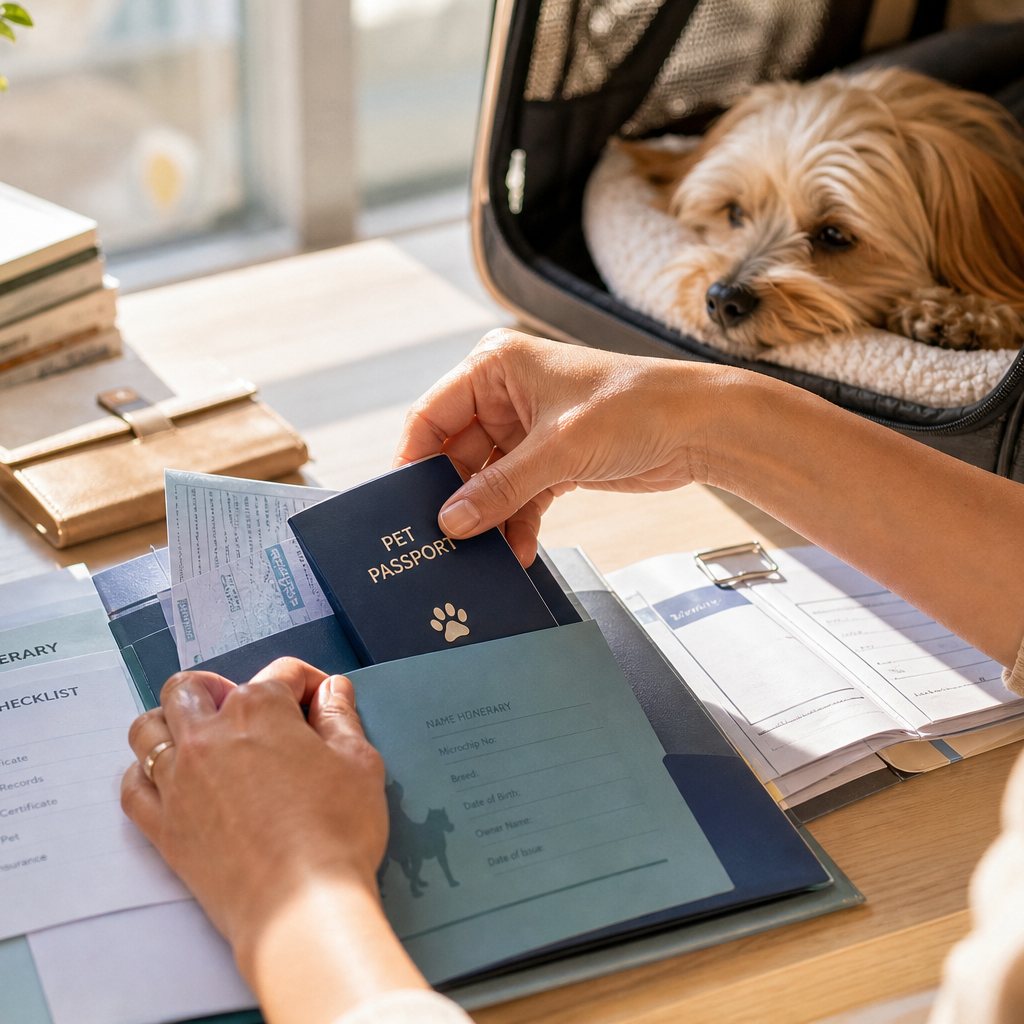
When traveling to Hawaii with your dog, it’s best to start preparing as early as possible. This is because you’ll need to handle three distinct types of preparations simultaneously—Japan’s export procedures, the Hawaii State Animal Quarantine Service (AQS), and U.S. federal CDC requirements—and there are time requirements for the two rabies vaccinations and the FAVN antibody titer test.
Start Preparing (As Soon as Possible)
- Verify that the microchip complies with both ISO 11784 and 11785 standards; if it has not been implanted, have it implanted before the rabies vaccination.
- Received the first dose of the rabies (inactivated) vaccine
- Verify the owner's passport and begin researching airline tickets and accommodations
About three months before departure
- Receive the second dose of the rabies vaccine (at least 30 days after the first dose)
- Book your flight and accommodations, and confirm your advance application to travel with your pet
2–3 months before departure (check to see if you meet the requirements set by the State of Hawaii)
- For travelers who have received two or more doses of the rabies vaccine in their lifetime, verify that at least 30 days have passed between the most recent dose and the scheduled arrival date, and confirm that they can present proof of all two doses. While receiving two doses of the vaccine is similar to the preparations for returning to Japan described in points 1 and 2 above, the Hawaii State AQS verifies not only the “number of days elapsed” but also “a history of two or more vaccinations in a lifetime and the complete set of certificates” (Source: Official Website of the Hawaii State Animal Quarantine Service (AQS))
- Conduct a FAVN titer test (limited to the OIE-FAVN method; must be performed by an approved testing facility). There must be an interval of at least 30 days between the date the testing facility receives the blood sample and the date of arrival (please note that the starting point is the date the sample is received, not the date of blood collection). Source: Official Website of the Hawaii State Animal Quarantine Service (AQS))
More than 10 days before departure
- Submit the complete set of required documents to the Hawaii State Animal Quarantine Station so that they arrive at least 10 days before your arrival (Source: Official Website of the Hawaii State Animal Quarantine Service (AQS)). This is the deadline for arrivals in Honolulu. If you are using a Neighbor Island Inspection Permit on neighboring islands such as Kona, Kahului, or Lihue, different procedures apply compared to arrivals in Honolulu—including document submission deadlines and prior coordination with designated veterinary facilities. Please check the same page for details and the latest deadlines.
- To apply for export inspections from Japan, submit an application via NACCS (Animal Quarantine-Related Services) at least 14 days prior to the desired inspection date (Source: Animal Quarantine Service)
Just before departure
- Within 10 days of departure, undergo an export inspection at an animal quarantine station and obtain an export quarantine certificate (Source: Animal Quarantine Service)
- Apply for the CDC Dog Import Form online (free). This is a U.S. federal requirement separate from the State of Hawaii’s quarantine procedures (Source: CDC)
- Confirm that the microchip can be read by a universal scanner and that the dog is at least 6 months old (CDC requirement; source as indicated in the link above).
Upon Arrival in Hawaii
- After arrival, follow the airport signs to the Animal Quarantine Service (AQS) counter.
- If you meet the requirements, you will be eligible for “Direct Airport Release,” which allows you to complete quarantine procedures at the airport without being transferred to a quarantine facility. However, since the time required may vary depending on document verification and the operating hours of the quarantine counter, be sure to plan your schedule with plenty of time to spare if you have a connecting flight. Please note that the rabies vaccination, FAVN antibody test, and document submission described in this article are the main requirements; additional verification steps may be required. Be sure to check the AQS official website for details before your trip.
- If you are arriving on neighboring islands such as Kona, Kahului, or Lihue, separate procedures are required (see below for details).
Well in advance of your return (at least 40 days before your scheduled arrival in Japan)
- Advance notification to the Japanese Animal Quarantine Station (submit to the Animal Quarantine Station with jurisdiction over the scheduled port of entry—airport or seaport—no later than 40 days before the scheduled arrival date in Japan)
Immediately before returning to Japan (within 10 days of departure from Hawaii)
- Obtain a health certificate issued by a government agency in the host country (the United States) certifying that the animal shows no signs of rabies or leptospirosis.
- Confirming with the airline about traveling with a pet and doing a final check of the required documents
Hawaii is included in the Animal and Plant Health Inspection Service’s list of “designated areas” (rabies-free areas) (Source: List of "Designated Areas" by the Animal Quarantine Service(Confirmed in July 2026). When returning from a designated region, the required procedures may vary depending on whether you can prove that your pet has been kept continuously in Japan or only in the designated region. The procedures for returning from a short-term trip such as this one areAnimal Quarantine Office: “Travel and Short-Term Stays for Dogs and Cats”This information is provided in the guide. The two-dose vaccination and antibody titer test mentioned in the timeline of this article are just one example of preparations for returning to Japan; since the specific procedures that apply vary by case, please check directly with your local animal quarantine office before departure. Please also keep in mind that you will need a health certificate issued by a government agency in the country you are visiting within 10 days prior to departure.
For those who have so many things to prepare that they can't keep track of them all
Please let us know your destination and your planned departure date.
Here is the required preparation period and the order of the procedures.
What are the differences between the requirements of the State of Hawaii’s Animal Quarantine Service (AQS) and those of the U.S. federal government (CDC)?
If you plan to bring your dog to Hawaii, you must comply with two separate sets of requirements: the animal quarantine regulations administered by the State of Hawaii (AQS) and the dog import requirements set by the U.S. Centers for Disease Control and Prevention (CDC). Since meeting only one of these requirements is not sufficient, it is important to verify that you meet both.
| Category | Main conditions | Primary sources |
|---|---|---|
| State of Hawaii AQS (Direct Airport Release) |
Rabies Vaccination (A history of at least two vaccinations in a lifetime and a complete set of certificates for both doses are required. At least 30 days must have passed between the most recent vaccination and the scheduled arrival date. The two-dose regimen itself is the same as that required for preparation to return to Japan) / FAVN Antibody Titer Test (OIE-FAVN method only. A period of at least 30 days must elapse between the date the testing facility receives the blood sample and the date of arrival. Approved testing facilities include Kansas State University, Auburn University, the University of Missouri, and the DOD Lab, among others) / Submit the complete set of required documents to the Animal Quarantine Station at least 10 days prior to arrival. The above are the main requirements. | Official Website of the Hawaii State Animal Quarantine Service (AQS) |
| U.S. Centers for Disease Control and Prevention (CDC) (Dog Import Form) |
The basic requirements are: the dog must be at least 6 months old; must be in good health upon arrival; must have a microchip that can be read by a universal scanner; and must carry a receipt for the online submission of the CDC Dog Import Form. However, whether additional vaccination certificates or tests are required depends on the dog’s travel and residence history. Be sure to check the CDC’s official website for the latest information on the requirements that apply to your specific situation. | CDC |
The table above summarizes the main requirements of both AQS and the CDC; however, the specific documents and procedures required may vary depending on the individual case. These CDC requirements, which took effect in August 2024, apply at all U.S. airports, seaports, and land border crossings, including those in Hawaii. Because these requirements were enacted in August 2024 and are relatively new, they are easy to overlook. Since the specific conditions that apply vary depending on your travel and stay history, be sure to check the latest information on the official AQS and CDC websites before traveling (the sources and verification dates for the table above are both July 2026).
What should I keep in mind when arriving on a neighboring island (Maui, Hawaii Island, Kauai)?
If you are arriving in Honolulu (Daniel K. Inouye International Airport), you may be eligible for Direct Airport Release, provided you meet the requirements. In this case, you will not be transferred to a quarantine facility and can complete animal quarantine procedures within the airport (the time required may vary depending on document verification and counter availability). On the other hand, if you arrive directly at an airport on a neighboring island—such as Kona, Kahului, or Lihue—you will need to apply for a separate permit called the Neighbor Island Inspection Permit (NIIP). The deadlines for submitting documents, the need for prior coordination with a designated veterinary facility, and the fee structure differ from those for arrivals in Honolulu.
| Arrival point | Procedures |
|---|---|
| Honolulu (Oahu) | If you meet the requirements, you are eligible for Direct Airport Release, which allows you to complete quarantine procedures at the airport without being transferred to a quarantine facility (the time required may vary depending on document verification and other factors). |
| Neighboring islands such as Kona, Kahului, and Lihue | A separate application for a Neighbor Island Inspection Permit (NIIP) is required. The deadline for submitting documents, prior arrangements with designated veterinary facilities, and the fee structure differ from those for arrival in Honolulu. |
If you plan to stay at a hotel on a neighboring island, such as Maui, and are considering an itinerary that takes you directly to an airport on that island, please be especially careful not to overlook the fact that the deadlines for submitting documents and the need for prior coordination with a designated veterinary facility differ from the aforementioned “at least 10 days prior to departure” (the deadline for arrivals in Honolulu). For details and the latest deadlines and fees, please seeHawaii State Animal Quarantine Official FAQ PagePlease check the table above (the source and verification date for the table above are July 2026).
How should I choose a place to stay?
When choosing a pet-friendly hotel in Hawaii, it’s important to consider the location, amenities, and pet policies as a whole. If you’re planning a long-term stay or need to manage your pet’s diet, it’s a good idea to check whether the room includes a kitchen. Since weight and number limits for pets, as well as additional fees, vary by hotel and are subject to change, this guide does not list specific prices. We recommend that you always check the official website at the time of booking.
Alohilani Resort Waikiki Beach
- A high-rise hotel along Waikiki Beach, within walking distance of the beach
- Since the weight and number of pets allowed, as well as any additional fees, are subject to change, please be sure toPolicy Page on the Hotel's Official Websiteplease check at
In addition to the options listed above, there are several pet-friendly accommodations in Waikiki, on Maui, and elsewhere. Since facility names and acceptance policies are subject to frequent changes, this guide does not list specific properties. Instead, we recommend filtering your search on booking sites using the “Pet-Friendly” filter and always checking the official website to confirm the current pet policy. Please note that if you are staying at a hotel on a neighboring island, such as Maui, and arriving directly at that island’s airport, you will need to obtain the aforementioned Neighbor Island Inspection Permit separately.
Since the selection of pet-friendly hotels with kitchens tends to be limited, we recommend booking early and checking the terms and conditions.
Can I enjoy restaurants and activities with my dog?
In Hawaii, there are restaurants—particularly those with outdoor seating—where you can enjoy a meal with your dog. However, since there may be multiple locations with the same name, and operating hours and pet policies may have changed, it’s essential to check before visiting.
Barefoot Beach Café(Queens Surf Beach, 2699 Kalākaua Ave) is a café with outdoor terrace seating located along the beach in Waikiki. While some sources indicate that dogs are allowed, pet policies and rules are subject to change, so before visiting,Official SiteBe sure to check the map app for both business hours and pet policies. Please also note that there may be stores with the same name but different addresses.
If you’d like to enjoy outdoor walks or hikes, Oahu has several dog parks and beaches where you can walk with your pet. However, since rules regarding pets and operating hours vary by facility and park and are subject to change, this guide does not list specific facility names. We recommend checking the official websites of the State of Hawaii and the respective county park departments, or consulting local tourist information centers, for the most up-to-date information on pet-friendly facilities.
Please note that Diamond Head State Monument, a popular hiking spot, does not allow pets, with the exception of service animals (Source: Hawaii State Parks (DLNR)(Confirmed in July 2026). Please note that you cannot bring your dog to this location. Additionally, starting in 2022, advance reservations are required for non-residents, and entry without a reservation is not permitted. Please check the official website for details, such as when reservations open (Source: Diamond Head State Monument: Reservation Information(Verified in July 2026).
How should I take care of my health and stay cool while I'm there?
While Hawaii has a relatively pleasant climate, temperatures can rise during the day. To stay safe, be even more mindful of heat precautions than you would be in Japan—such as taking walks in the early morning or evening, staying hydrated frequently, and bringing cooling items.
If you have any concerns about drinking water or how to feed your pet, it’s a good idea to consult your regular veterinarian before you leave.
If you're unsure about how much to feed your pet or how to feed it after the move, be sure to check with your regular veterinarian in advance.
Since the local climate differs from that of Japan, be sure to use the air conditioning at your lodging to create a comfortable environment for your dog.
If you notice anything unusual, consult a local veterinary clinic as soon as possible.
What procedures are required when returning to Japan?
When returning to Japan, you must complete two procedures: advance notification to Japanese authorities and obtaining a health certificate from the country where you stayed in Hawaii. Since both have specific deadlines, it’s best to factor them into your schedule before your trip. Additionally, Hawaii is designated as a “designated area” by the Animal Quarantine Service, and the specific procedures required may vary depending on whether you can prove that your pet has been kept continuously in Japan or within a designated area.
- Advance notification to Japan's Animal Quarantine Service — You must submit a notification to the animal quarantine office with jurisdiction over the airport or seaport of your intended arrival at least 40 days before your scheduled arrival in Japan. You must bring the accepted documents with you when you return to Japan.
- Obtaining a health certificate issued by a government agency in the host country (the United States) — You must be examined within 10 days of departure from Hawaii and obtain certification that you show no signs of rabies or leptospirosis.
- Confirmation with the Airline — We will process your reapplication to bring your pet and finalize the required documents.
If you do not meet the requirements—such as having your pet microchipped before departure, receiving two doses of the rabies vaccine, and undergoing an antibody titer test—your pet may be subject to a quarantine period of up to 180 days upon arrival in Japan. Completing the preparations outlined in the section “When Should I Start Preparing for My Trip?” before departure is a key factor that will determine the length of your pet’s quarantine period upon your return (Source: Animal Quarantine Office: “Travel and Short-Term Stays for Dogs and Cats”(Verified in July 2026).
Although Hawaii is included in the Animal Quarantine Service’s list of “designated regions,” being a designated region does not automatically mean that the preparations mentioned above are unnecessary. Since the specific procedures and requirements that apply—including whether you have proof that the animal has been kept exclusively in Japan or a designated area—vary on a case-by-case basis, please also refer to the section “When Should I Start Preparing for My Trip?” mentioned earlier regarding pre-travel preparations, and contact the Animal Quarantine Service directly if you have any questions.
What are some common mistakes and things to watch out for during preparation?
For details and the latest information on the regulations mentioned above, regarding the CDC Dog Import Form, please seeCDC Official Website, Regarding the Neighbor Island Inspection Permit upon arrival on a neighboring island:Hawaii State Animal Quarantine Official FAQ Page, Regarding advance notification by the Japanese side (at least 40 days in advance),Animal Quarantine Office: “Travel and Short-Term Stays for Dogs and Cats”Please check the following (all verified in July 2026).
What can PetAir do?
PetAir provides a full range of support services for traveling to Hawaii with your dog, including guidance on preparing the necessary documents, organizing information regarding animal quarantine procedures, assistance with airline arrangements, guidance on customs clearance, and handling the handover at the airport. If you let us know your planned travel dates and your pet’s condition, we’ll advise you on the necessary preparation time and the steps to follow.
We do not prepare documents or submit applications on your behalf; our services primarily focus on organizing the necessary information and guiding you through the procedures. We do not guarantee entry into the destination country, confirm flight reservations, or certify your pet’s health status. Please consult with your pet’s owner and your regular veterinarian regarding vaccinations and health management. Fees vary depending on the destination, travel dates, and your pet’s condition; we will provide an estimate when you contact us.
Frequently Asked Questions (FAQ)
Summary: Get the three types of procedures sorted out early
When traveling to Hawaii with your dog, the key is to organize three distinct procedures simultaneously: export preparations in Japan, the State of Hawaii’s animal quarantine (AQS·Direct Airport Release), and the U.S. federal CDC Dog Import Form. If you’re arriving directly on a neighboring island, such as Maui, you’ll also need to confirm that you have a Neighbor Island Inspection Permit.
Since regulations and procedures are subject to change, be sure toAnimal Quarantine ServicePlease check the latest information on the official websites of the relevant authorities, such as the Hawaii State Animal Quarantine Office and the CDC. If you factor the procedures for returning home into your schedule before you leave, you’ll be able to enjoy your stay there with peace of mind.
🐾 Traveling to Hawaii with Your Dog: Start with a Free Consultation
Please let us know your destination, desired departure date, and pet situation.
A summary of the required procedures and deadlines will be provided.
Completely free of charge|Online support available|Open on weekends and holidays
Written by: PetAirJPN Editorial Department (International Pet Transportation Operations Team)
*The information in this article is current as of July 2026. Quarantine regulations in various countries and regions, as well as airline policies, are subject to change without notice. This article is intended to provide general information only. To determine whether travel is permitted and to confirm specific requirements, please be sure to check the latest official information from relevant authorities—such as the Animal Quarantine Service, the State of Hawaii’s animal quarantine agency, and the CDC—as well as the airlines.

 English
  Japanese
  Chinese
  Korean
  German
  Spanish
  Portuguese