
![How to Choose a Pet Crate | IATA Size Standards and Safety Measures [2026 Edition]](https://petair.jp/wp-content/uploads/2024/06/b215f710bddb1899399edbeae106b61d.webp)
Last Updated: July 29, 2026
Why Is Choosing the Right Crate Key to a Safe Flight?
When traveling with your pet or moving and using air travel, the choice of a transport crate (carrier or cage) plays a major role in ensuring your pet’s safety and minimizing stress. This is because, in the unfamiliar environment of the cargo hold, the right crate helps reduce the risk of injury, escape, or illness during transport.
Conversely, crates that are the wrong size or do not meet structural standards may be refused for transport at airport check-in. This guide focuses primarily on situations where crates are transported as checked baggage in the cargo hold and explains the essential points to consider when selecting a crate, step by step.
How Do You Measure Your Pet's Size? 4 Ways to Take Measurements
The first step in selecting a crate is to know the exact size of your pet. Measure the following four dimensions with your pet standing naturally.
- A: Body length(From the tip of the nose to the base of the tail)
- B: Height to elbow(From the ground to the elbow joint of the front leg)
- C: Body width(widest part, such as shoulder width)
- D: Body height(From the ground to the top of the head. For dogs with erect ears, up to the tips of the ears.)
Tips for Taking Measurements
- Use a soft measuring tape and measure along your body.
- If your pet keeps moving, it will be easier to take measurements if two people work together or if you use a wall or similar surface for support.
- If you take several measurements and use the largest one, you'll be less likely to choose the wrong size.
How Do You Determine the Internal Dimensions of a Crate? The IATA Standard Formula
The internal dimensions of the crate are determined based on your pet's measurements. The International Air Transport Association (IATA) has established a formula for calculating the minimum required internal dimensions, and many airlines follow this standard.
IATA Standard Calculation Formula (Minimum Internal Dimensions of the Crate)
- Length = A (body length) + 1/2 B (height to the elbow)
- Width = C (body width) × 2
- Height = D (height at withers) + thickness of the mat
This is merely a minimum standard.For brachycephalic breeds (dogs and cats with flat faces), a size approximately 10% larger than this is recommended.(Source: IATA Live Animals Regulations, Container Requirement 1(Verified in July 2026).
The formulas are only a guide. Most important,Can your pet comfortably perform the following actions inside the crate?That is the functional requirement.
If you're unsure, choose a slightly larger size and be sure to check the regulations of the airline you'll be flying with. If it's too small, you risk being denied boarding, and if it's too large, your body may shift around and feel unstable during transport.
What safety standards should be checked regarding the structure of a crate?
There are four safety standards to check regarding the crate’s construction: material, securing method, ventilation opening size, and door latch. Once you’ve decided on the size, make sure the crate meets these standards. Airlines have detailed regulations in place to ensure safe transport.
What material should I choose?
| Category | Details |
|---|---|
| Available for use | Rigid Plastic |
| Available for use | Metal, fiberglass |
| Available (subject to conditions) | Wood or plywood (with side walls at least 12 mm thick for dogs and at least 6 mm thick for cats, etc., in compliance with IATA regulations) |
| NG | Fabric, rattan, foldable, made entirely of wire mesh or lattice, cardboard, etc. (insufficient strength, posing a risk of damage or escape) |
The standards for materials and strength are general guidelines based on IATA regulations. Since specific requirements may vary depending on the airline you are using, please check with them as well (Source: IATA Container Requirement 1(Verified in July 2026).
What should I do about the structure and mounting method?
The floor should be sturdy and waterproof, with a design that prevents waste from leaking out. The roof should also be made of sturdy material and be strong enough to withstand the weight of other cargo placed on top without breaking or becoming damaged. If you plan to use a model with an opening in the roof, it’s a good idea to check before purchasing to ensure that the opening is designed so it won’t get blocked by other cargo.
Split-top crates are,Items secured only with plastic clips cannot be used.IATA recommends securing all holes with metal bolts and nuts (Source: IATA CR1, cited above; verified in July 2026). Since clips that come loose due to impacts during transport can cause damage or allow animals to escape, be sure to check the securing method before purchase or use.
How many vents are needed?
The crate must have adequate ventilation openings on all four sides.According to IATA standards, the total ventilation area of all four sides must be at least 16% of the total side area (Source: IATA CR1, cited above; verified in July 2026). The mesh of ventilation openings and doors must be fine enough to prevent a pet’s nose or claws from protruding. As a guideline, the maximum mesh size should be 2.5 cm square for dogs and 1.9 cm square for cats. If the mesh is too large, reinforce it from the inside with fine-mesh wire or similar material.
In addition, IATA requires that spacers (protrusions or edges) be installed on both sides and the back of the crate to prevent other cargo from blocking the ventilation openings.
What about the door and the lock?
The door must be made of plastic, wood, plywood, or welded or cast metal, and must be thick enough to prevent bending or warping even when the pet leans its weight against it. If a plastic door is used, the hinges and locking pins must be made of metal. The standard requires that the locking pin be designed to be inserted at least 1.6 cm into the hole in the crate body (Source: IATA CR1, cited above; confirmed July 2026). The lock must be secure and designed so that the pet cannot open it from the inside.
If the crate has wheels (casters), be sure to remove them or secure them completely with tape or similar material to prevent the crate from moving during transport. Also, check to make sure there are no sharp protrusions inside the crate.
Crates that do not meet these standards may be refused at check-in at the airport. If you are unsure whether your crate meets the standards, please feel free to contact PetAir.
What should I keep in mind when transporting brachycephalic breeds or multiple pets?
Since brachycephalic breeds are at a higher risk of heatstroke and respiratory distress than other breeds, it is essential to use a large, well-ventilated crate and to confirm requirements with the airline in advance. When transporting multiple pets, the general rule is one pet per crate.
Brachycephalic breeds (Pugs, French Bulldogs, Bulldogs, Shih Tzus, etc.)
Brachycephalic breeds have physical characteristics such as short noses and narrow airways (Brachycephalic Airway Syndrome: BOAS). As a result, they are considered to be at a higher risk of respiratory distress and heatstroke caused by heat or stress than other dog and cat breeds, and may become ill during transport.
Many airlines restrict or suspend the transport of brachycephalic breeds, particularly during the summer, and an increasing number of airlines do not accept them at all, regardless of the season.Depending on the airline, even if the crate meets the size and ventilation requirements, some airlines may not accept brachycephalic breeds for transport in the cargo hold at all, or may exclude certain dog or cat breeds from this service.(Source: IATA Live Animals Regulations Addendum I(Confirmed in July 2026). Since the eligible dog breeds and time periods vary by airline,Be sure to check the latest regulations of the airline you plan to use and consult with your veterinarian in advance regarding your pet’s fitness to fly.If you’re preparing a crate, as mentioned earlier, use one that’s about 10% larger than usual and well-ventilated, and pay special attention to temperature control (such as using a cooling mat). Acceptance policies vary by airline, soCan Snub-Nosed Breeds Fly? Airline-by-Airline Acceptance Policies & What You Can DoThis is summarized in detail here.
When transporting multiple pets in the same crate
The general rule is "one crate per dog."In the confined space of an aircraft, even pets that usually get along well may become aggressive due to stress or accidentally injure one another. For this reason, many airlines require that only one pet be placed in each crate.
IATA regulations provide for an exception allowing up to two adult animals weighing 14 kg or less that normally live together, or up to three young animals under 6 months of age and weighing 14 kg or less that normally live together, to be transported in the same crate. However, thisYou must always get permission from the airline in advance, andYou must provide a crate large enough for each pet to stand, turn around, and lie down comfortably. In this case, use the following guidelines for the internal width: C (body width) × 3 for two pets, and C × 4 for three pets. Be sure to choose a size that allows for plenty of room (Source: IATA CR1, cited above(Confirmed in July 2026). For safety reasons, we strongly recommend transporting them one at a time in separate crates whenever possible.
Are you worried about whether the crate you're choosing is right for your pet?
Please let us know the dog's breed, size, and travel plans.
Let's go over how to choose the right crate together.
How Should You Prepare the Inside of the Crate? Bedding, Water, Food, and Identification Information
Inside the crate, prepare four items: a highly absorbent mat, a secure water bowl, a light meal before departure, and a piece of paper with your pet’s identification information. Once you’ve chosen the crate, set up the interior to ensure your pet’s comfort and safety.
Bedding
It is essential to place highly absorbent items (such as pet pads, absorbent mats, or towels) on the bottom of the carrier. This will prevent your pet from getting wet if it relieves itself during transport. Putting a towel or blanket with a familiar scent inside the carrier can help your pet feel more at ease. However, avoid items that pose a risk of accidental ingestion, suffocation, or entanglement (such as cushions with stuffing or easily torn toys), and be careful not to block the ventilation openings with the bedding.
drinking water
You’ll need a water container that can be securely fastened to the crate. We recommend freezing the water beforehand and placing it in the container; this way, your pet can drink as it melts, and it’s less likely to spill. Regulations regarding the type of water container (tray-style or nozzle-style) vary by airline. For example, on ANA international flights, only nozzle-style water containers are accepted for check-in (tray-style containers are not permitted due to the risk of spills) (Source: ANA International Flights Page(Confirmed in July 2026). Be sure to check with the airline and on the route you plan to fly when making your reservation to see what type of water container they require. If you’re using a nozzle-type container, it’s a good idea to make sure your pet is familiar with how to use it beforehand.
Food
Generally, pets should not be fed during transport (to prevent aspiration). They should have a light, easily digestible meal at least two hours before departure (Source: IATA CR1 cited above, “A light meal at least two hours before departure,” verified in July 2026). Transporting your pet on a full stomach can cause motion sickness or vomiting. In case of an emergency or delay, it is recommended to secure an empty food bowl inside the crate or place a small amount of dry food in a plastic bag and attach it to the outside of the crate.
temperature control
During the summer, you can use a cooling mat or wrap a frozen water bottle in a towel and place it next to the crate (please note that items that cannot be secured inside the crate may not be permitted by some airlines). In the winter, you can add a blanket or attach a disposable pet-safe heating pad to the outside of the crate (in a place where your pet cannot touch it directly). However, please take great care to ensure safety—avoiding cold burns or accidental ingestion—and follow the airline’s instructions.
identification information
The “Live Animals” label and the “This Way Up” arrow label are typically provided and affixed by the airline at check-in. In addition, it’s helpful to place a piece of paper—containing your pet’s name, breed (dog or cat), gender, and age; the owner’s name, address, and emergency contact information; destination details; and flight number—in a waterproof bag (such as a Ziploc bag) and attach it securely to the outside of the crate, just in case.
Before putting your dog in the crate, be sure to remove all collars, harnesses, clothing, leashes, GPS trackers, and other items.If these items get caught in the bars or gaps inside the crate, they can cause suffocation or injury (Source: IATA CR1, cited above; verified in July 2026). Identification information, such as contact details, can be adequately conveyed using a piece of paper placed in the waterproof bag mentioned earlier. Do not place items such as toys, chew toys, or bones in the crate, as they pose a risk of accidental ingestion or suffocation.
How Should You Prepare Your Pet? Crate Training and Health Care
When preparing your pet for travel, the most essential steps are crate training—which takes several weeks to several months—and a pre-trip health checkup and verification of the necessary documents. It’s no exaggeration to say that this pre-trip crate training is what determines whether air travel will be a success or a failure.
Goals of Crate Training
The goal is to help your pet see the crate not as a “scary place where they’re locked up,” but as “their own safe and cozy den.”
Starting the Break-in Period (a few weeks to a few months in advance)
A few weeks to a few months before the trip, place the crate in your daily living space and leave the door open so your pet can come and go as it pleases.
Positive Associations
Give your dog treats inside the crate or place its favorite safe toys inside to help it associate the crate with something positive.
Extend the length of stay
Once your pet is comfortable staying inside the crate, try closing the door. Start with just a few seconds at first, and gradually increase the time.
Practicing When the Owner Leaves
With the door closed, have the owner step back a little. Start with a short period of time, and gradually increase both the distance and the duration.
During training, it’s important not to put your dog in the crate as a punishment for misbehaving, not to open the door immediately when your dog barks (instead, praise your dog when it quiets down), and if your dog seems reluctant, don’t force it—just go back to the previous step.
Health Management and Required Documents
Be sure to consult your regular veterinarian in advance and have your pet undergo a health checkup to confirm that it is fit for air travel. This is especially important for senior pets, pets with pre-existing conditions, pregnant pets, and brachycephalic breeds.
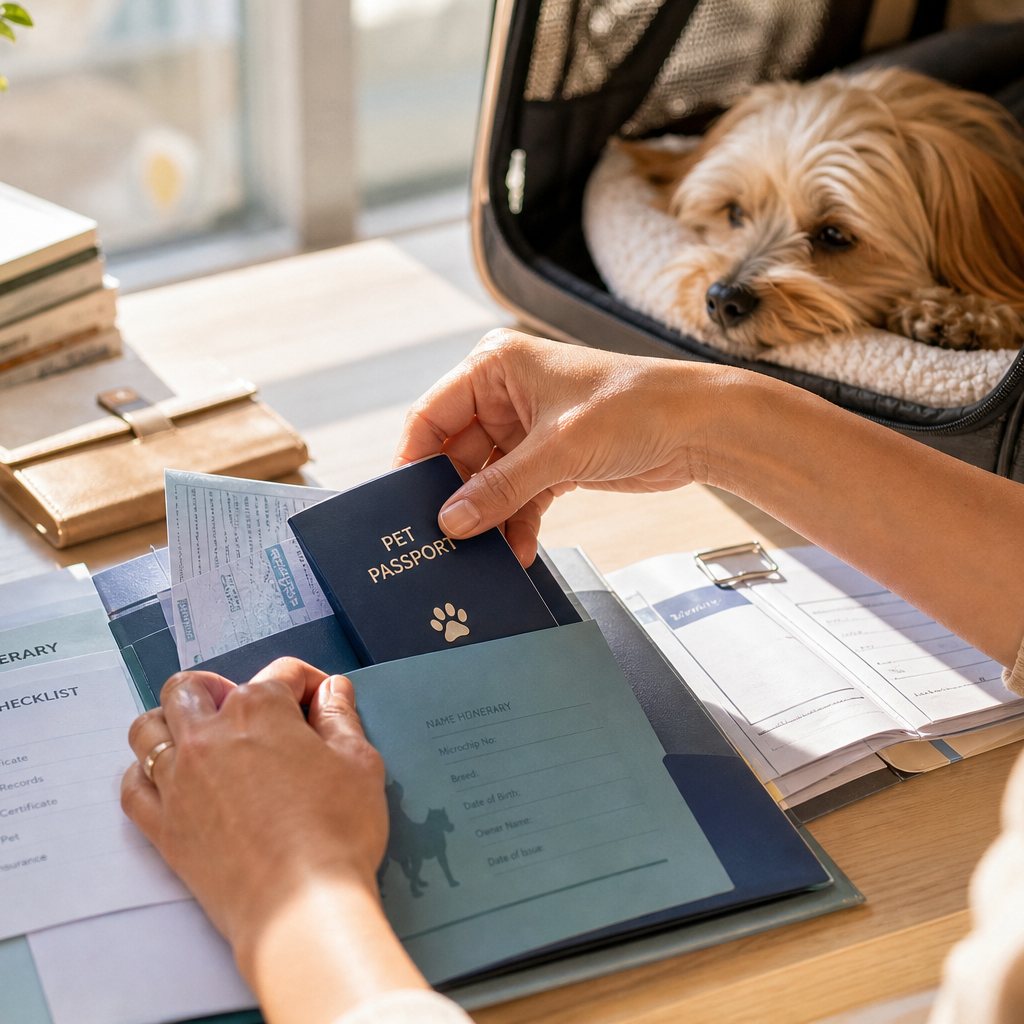
The validity period of health certificates is determined by the airline and the destination country. Since certificates may not be accepted once they have expired, be sure to check with your airline and the destination country’s authorities to determine when to have the certificate issued, working backward from your departure date. Proof of vaccination for diseases such as rabies is often required, and for international flights, microchipping and registration are frequently mandatory. Therefore, it is essential to check and prepare well in advance for the import permits and quarantine procedures required by your destination. Regarding rabies vaccinations and microchipping,The Basics of Rabies Vaccination You Should KnowandThe Complete Guide to Microchipping Dogs and CatsThis is explained in detail there.
About Sedatives
As a general rule, do not use sedatives.Many airlines and veterinary organizations do not recommend the use of sedatives because they dull the body’s natural response to changes in air pressure and the environment, thereby increasing the risk of unexpected and serious side effects, such as respiratory depression (Source: IATA Container Requirement 1(Confirmed in July 2026). Even if a veterinarian prescribes a sedative for medical reasons, you must always notify the airline in advance and obtain permission. Please refrain from using sedatives without authorization.
Pre-departure care
- Hydration:It's fine to give them water right up until departure.
- Walking and defecation:Before heading to the airport or checking in, make sure your dog has had a good walk and a chance to relieve itself.
- Nail clippers:Trim your cat's nails beforehand to prevent them from getting caught in the mesh of the crate or similar surfaces.
What's the process on the day of your flight? Final checks before boarding
On the day of your flight, follow these steps: make a final confirmation with the airline a few days before departure, arrive with plenty of time to spare, and have your documents and crate checked at check-in. Once everything is ready, it’s time to depart.
Final confirmation with airline (several days before departure)
Since regulations may change even after you've made your reservation, be sure to check the following points with the airline again a few days before departure.
Make sure to leave plenty of time to get to the airport
Check-in for pets often takes longer than the standard check-in process. Since the airline will verify documents, assess your pet’s condition, and inspect the carrier, be sure to arrive at the airport well in advance of the airline’s designated cutoff time. Specific check-in deadlines vary by airline and route, so it’s best to confirm them when you make your reservation. If you arrive late, you may not be allowed to board.
check-in
At the designated counter, present your pet, its carrier, and the required documents. A staff member will check your pet’s health, verify that the carrier meets regulations, and ensure the documents are complete. If any issues are found at this stage, your pet may be denied boarding. Pay the fee, and allow your pet to relieve itself and drink water one last time before placing it in the carrier. Once your pet is in the carrier, double-check to make sure the door is securely locked. If you appear anxious, your pet will sense it, so stay calm, speak gently to your pet, and say goodbye.
Common Mistakes and Points to Keep in Mind
There are several common pitfalls to watch out for when choosing and preparing a crate.
Frequently Asked Questions (FAQ)
Summary: Choose a crate that meets both accurate measurements and safety standards
Traveling by plane with your pet can be a source of many concerns, but thorough preparation will give you peace of mind. Let’s go through the following steps one by one.
- Measure:Start by accurately measuring your pet's size.
- Select:Use the calculation formula as a general guideline, and choose a crate that is large enough for your pet to move around comfortably inside and has a sturdy construction that meets airline safety standards. It is especially important that the crate is secured with bolts and nuts.
- Preparedness:Make the inside of the crate comfortable by using an absorbent mat and a fixed-position water dispenser. Above all, get your pet used to the crate (crate training), ensure it’s in top health, and prepare the necessary documents well in advance.
- Confirmation:Be sure to check the latest information from your airline and familiarize yourself with any restrictions on brachycephalic breeds, as well as the required documents and procedures. Make sure to arrive at the airport well in advance.
By carefully following these steps one by one, you can minimize stress and risks for your pet during transport and make it easier to ensure a safe flight. The acceptance policy for brachycephalic dog breeds isSummary of Acceptance Status by Airline, The estimated time required for the entire shipping process isA Guide to the Time Required for Pet Transportation ProceduresPlease see this as well.
🐾 Air Travel for Pets: Start with a Free Consultation
Please let us know the dog's breed, size, destination, and your preferred departure date.
We'll provide a comprehensive guide covering everything from choosing a crate to the necessary procedures.
Completely free of charge|Online support available|Open on weekends and holidays
Written by: PetAirJPN Editorial Department (International Pet Transportation Operations Team)
*The information in this article is current as of July 2026. Quarantine regulations in various countries and airline policies are subject to change without notice. This article is intended to provide general information only; to determine whether a specific crate meets the requirements or if your pet is eligible to travel, please be sure to check the latest official information from the airline you plan to use and the IATA.

 English
  Japanese
  Chinese
  Korean
  German
  Spanish
  Portuguese