
Last Updated: August 1, 2026
For owners of brachycephalic breeds such as French Bulldogs and Pugs who are about to be assigned overseas, move abroad, or go on a trip, the first question that comes to mind is, “Can my dog fly on an airplane?”
What this article will tell you
- Medical reasons why flying is considered particularly stressful for brachycephalic breeds
- Acceptance Policies for Brachycephalic Breeds by Major Airlines [As of August 2026]
- A practical way to go abroad with a shorthorse.
- Preparation and documents required before traveling to Japan
- Common mistakes and workarounds
What kind of dog or cat is a short-headed breed?
List of typical short-horned breeds
The term “brachycephalic breeds” refers to dog and cat breeds with short noses and flat facial structures. While they are highly popular for their adorable appearance, this very skeletal structure poses a risk during air transport.
| classification | Typical varieties |
|---|---|
| Dogs (short-headed) | French Bulldogs, English Bulldogs, Pugs, Boston Terriers, Shih Tzus, Boxers, Cavalier King Charles Spaniels, Pekingese, Chow Chows, Affenpinschers, etc. |
| Cats (short-headed) | Persian, Exotic Shorthair, Himalayan, Burmese, Scottish Fold (some), etc. |
Why Do Brachycephalic Breeds Face Greater Strain on Airplanes? (Medical Reasons)
Brachycephalic breeds tend to have anatomical characteristics—such as narrow nasal passages, a long soft palate, and a narrow trachea—that, to varying degrees, are often referred to as “Brachycephalic Obstructive Airway Syndrome (BOAS).” While the presence and severity of symptoms vary from dog to dog—and not all dogs experience the same respiratory strain—dogs with these anatomical features are generally considered to be more prone to respiratory strain even under normal conditions.
Pressure and temperature conditions in an aircraft’s cargo hold fluctuate more easily than in the passenger cabin, which increases the stress on pets during the summer—when temperatures tend to be higher—and on long-haul flights. For brachycephalic breeds, which have difficulty breathing, this environment can increase the risk of heatstroke and respiratory distress. The American Veterinary Medical Association (AVMA) has also outlined the risks associated with transporting brachycephalic breeds in the cargo hold, which is why many airlines have established their own restrictions (Source: AVMA “Air Travel and Short-Nosed Dogs FAQ”(Confirmed in August 2026).
Acceptance Policies for Brachycephalic Breeds on International Flights [As of August 2026]
Policies regarding the acceptance of brachycephalic breeds vary significantly by airline; while many restrict their transport in the cargo hold, some airlines accept them under certain conditions, and in some cases, there may be room for them to be carried in the passenger cabin. Please note that the term “cargo” can refer to both the method of loading the pet as checked baggage in the cargo hold of a passenger flight and the method of transporting it as dedicated air cargo, and the specific treatment varies by airline. Please check directly with the airline you plan to use to determine which category applies. Below is a summary of the latest policies for major airlines.
List of Shorthorns Accepted or Not by Major Airlines
| airline company | Short-breed (dog) accepted | remarks |
|---|---|---|
| ANA (All Nippon Airways) | Varies depending on transportation method and season | For checked baggage (in the cargo hold on the same passenger flight), acceptance of brachycephalic breeds is restricted only during the summer season (May 1–October 31); during other seasons, they are accepted under certain conditions. It is generally considered difficult to bring these pets into the passenger cabin (please check the official website for the latest information on acceptance). ANA Cargo (separate cargo service) does not accept brachycephalic breeds year-round. Please be sure to check the latest official guidelines. |
| JAL (Japan Airlines) | Varies by breed | Bulldogs and French Bulldogs are not eligible for checked baggage. For other brachycephalic breeds, including Pugs and Boston Terriers, separate rules apply regarding which breeds are excluded from checked baggage and which are excluded from international cargo. Please be sure to check the official JAL guidelines to confirm which category your dog’s breed falls under and how it will be handled. |
| American Airlines (AA) | Not Accepted as Cargo | We do not accept any dogs—including brachycephalic breeds and mixed breeds—in the cargo hold. However, they may be allowed as carry-on luggage (provided they meet the weight limit and fit under the seat). |
| United Airlines | Not accepted as cargo (unconfirmed) | Although there are several reports stating that United Airlines “does not” accept brachycephalic breeds in the cargo hold, we have not been able to directly verify this information from the official website. If pet owners wish to have their pets transported in the cargo hold, using a specialized pet transport service is another option. Be sure to check directly with United Airlines before your trip. |
| KLM Royal Dutch Airlines | Many brachycephalic breeds are not eligible for transport in the cargo hold (checked baggage). | Several brachycephalic breeds are excluded from travel in the passenger cabin’s cargo hold (as checked baggage). The passenger cabin cargo hold and air cargo (cargo transport via dedicated cargo flights) are separate categories, and the eligible dog breeds and conditions may differ; therefore, please be sure to check the official KLM website to confirm which category applies to your dog’s breed and how it will be handled. In some cases, it may be possible if your dog fits within the carry-on size limits. |
| Turkish Airlines | Generally not allowed (not officially confirmed; individual confirmation required) | Multiple independent sources state that, as a general rule, brachycephalic breeds are not permitted to be transported in the cargo hold or as checked baggage. However, we have not been able to directly verify this information on the official website, and since there have been reports in the past indicating that such dogs were accepted under certain conditions, we cannot confirm the exact current policy. Carriage in the cabin (limited to small sizes) may be permitted in some cases. Be sure to check directly with Turkish Airlines before your trip. |
| Deutsche Lufthansa (German airlines) | Not permitted in the cargo hold (checked baggage) (unconfirmed by the airline; air cargo is a separate category) | There are several reports indicating that brachycephalic breeds are not accepted in the cargo hold of passenger flights (as checked baggage). Since the cargo hold and air cargo (dedicated cargo transport by Lufthansa Cargo) are separate categories—and the eligible dog breeds and conditions may differ—please be sure to check directly with Lufthansa before your trip to confirm which category applies and what the specific conditions are. Carry-on travel may be permitted for small-sized dogs only. Additional temperature restrictions may apply during the summer months. |
| Emirates Airline | Generally not allowed (exceptions may apply depending on the time of year) | SkyCargo does not accept certain brachycephalic dog breeds for transport as cargo. Depending on the time of year, there may be exceptions under certain conditions. Please be sure to check the company’s official website for the applicable periods and conditions. |
Sources (official websites of each company, verified in August 2026): ANAinterpoint (interword separation)JAL Official FAQinterpoint (interword separation)American Airlines Cargointerpoint (interword separation)United Airlinesinterpoint (interword separation)KLMinterpoint (interword separation)Turkish Airlinesinterpoint (interword separation)Lufthansainterpoint (interword separation)Emirates SkyCargo. However, for United Airlines, Turkish Airlines, and Lufthansa, we have not been able to verify the information directly on their official websites; our verification is based solely on multiple secondary sources. Since policies are subject to change, please be sure to check the latest information on each airline’s official website before traveling.
Summer restricted period (rules vary by season)
ANA restricts the acceptance of brachycephalic breeds for transport in the checked baggage hold during the summer season (May 1–October 31); during other seasons, they are accepted under certain conditions. On the other hand, ANA Cargo (a separate cargo service) does not accept brachycephalic breeds year-round. During the summer, when temperature control in the cargo hold becomes more difficult, other airlines may also revise their acceptance conditions; however, as these conditions vary by airline, we recommend that you contact your airline directly and well in advance if your travel plans fall during the summer.
Difference between cargo compartment (cargo) and carry-on
Restrictions on brrachycephalic breeds primarily apply to “transportation in the cargo hold.” Some airlines allow small brachycephalic breeds to be carried in the cabin if they fit within the dimensions and weight limits for carry-on carriers specified by the airline (since these standards vary by airline, be sure to check the official website of the airline you’re using). However, on international flights, many routes and airlines prohibit bringing pets on board altogether.
When moving abroad or traveling long distances, using “dedicated cargo flights” or “specialized pet transport services” is a practical option for medium-sized or larger brachycephalic breeds.
Traveling with Brachycephalic Pets: Please Consult Us Before Giving Up
Even if you think, “My child can’t ride,” there are cases where you’ll find options once you discuss it with an expert. Start with a free consultation.
How to still go abroad with your pet
Even for brachycephalic breeds, travel options may be expanded through three approaches: utilizing cargo flights and specialized transport services, carefully planning stopovers and travel times based on the season, and having a veterinarian confirm the dog’s fitness for travel in advance. Let’s take a closer look at each of these.
Using freight and specialized transportation services
If it is difficult to transport your pet as cargo on a regular passenger flight, you can also use specialized air transport services for pets—which are based on widely accepted international standards such as the IATA Live Animals Regulations—or arrange transport through a specialized broker. Since service details, temperature control, and ventilation standards vary by provider, please check with each company for details if you are considering using these services.
PetAirJPN assists you in selecting the appropriate transportation route, airline, and arrangement company for your shorthorse travel. For details, please contactThe Complete Guide to International Pet Air TransportationSee also.
Devise a transit point, season, and route
Even for the same destination, the likelihood of your pet being accepted can vary depending on the airline, the season, and the route you choose. It may be helpful to travel during the fall through spring (avoiding the summer), choose direct flights or routes with few layovers, and select airlines with flexible policies regarding brachycephalic breeds.
Obtain a suitability check at a veterinary clinic in advance.
Before considering travel, we recommend consulting your regular veterinarian about your dog or cat’s breathing and overall health. In cases of severe BOAS, breathing may improve with surgery (such as soft palate resection). From an animal welfare perspective, it is important to have a veterinarian assess your pet’s fitness for travel before deciding whether to travel.
Things to prepare before traveling to Japan
When preparing to travel with a brachycephalic breed, it’s important to start planning earlier than you would for a typical pet trip. The following timeline outlines a general schedule to follow starting six months before your trip.
More than 6 months prior to travel: Policy decision/route confirmation
- Research short-horse policies by airline.
- Check the animal quarantine requirements of the destination country (if a rabies antibody titer test is required, allow plenty of time for preparation). An overview of the export procedures from Japan isquarantine station for animals(You can check this at...)
- Consult with your family veterinarian to see if you can travel
- Free consultation with PetAirJPN to understand the overall schedule
5 months before travel: Start of quarantine procedures
- microchipFitting Verification (Compliant with ISO 11784 and 11785)
- rabies vaccineInoculation and acquisition of certificates for
- If the destination country requires a rabies antibody titer test, arrangements must be made for blood collection and testing (since reference values and the timing of the test vary by country and region, for details,quarantine station for animals(Please check the latest information on [...], etc.)
3 months before departure: Confirmation with airline and preparation of documents
- Check directly with your airline for the latest conditions for shorthorse acceptance.
- Complies with the standards set by the airlineSelection of cage/crate
- Start of Issuance of Health Certificates, Export Quarantine Certificates, etc.
- Prior import permit application required for some destination countries
1 month before departure: Final documents and preliminary arrangements
- Animal Quarantine Office (For Exporting Dogs and Cats)Booking an Export Inspection
- Issuance of health certificate (note expiration date immediately prior to travel)
- Final confirmation of pet onboard reservations with the airline
- Arrangement of transportation to the airport and pet cab on the day of the event
1 week before departure: Final check
- Confirmation of expiration date and contents of all documents
- Practice breaking in pets to cages
- For shorthorns, pay special attention to the temperature and physical condition on the day of travel.
- Confirmation of schedule for attending animal quarantine at the airport on the day of the visit
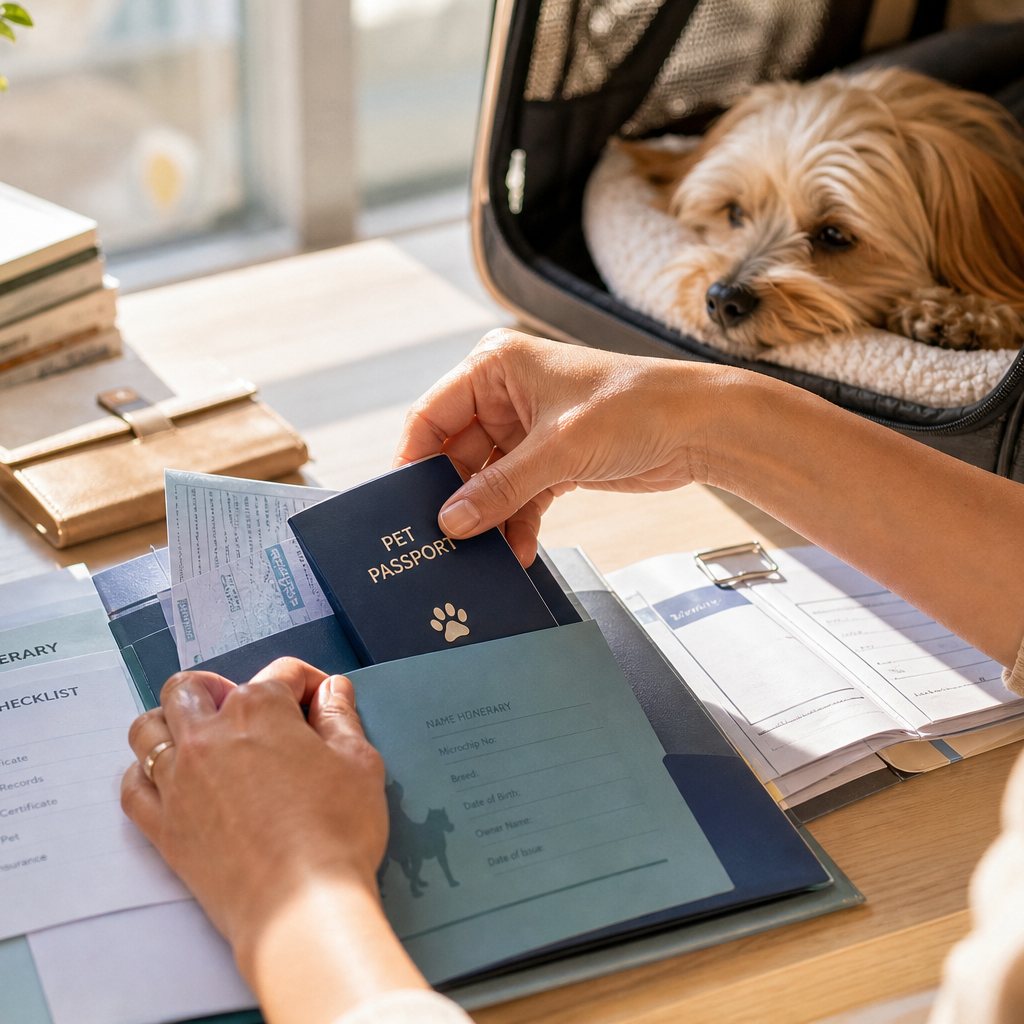
List of main required documents and conditions
| required items | Contents | remarks |
|---|---|---|
| microchip | Compliant with ISO 11784 and 11785 | If not fitted, must be fitted at a veterinary clinic |
| Proof of rabies vaccination | Documents proving that the vaccination is still within the validity period | Note the time period between inoculation and issuance of certificate. |
| Rabies antibody titer test | You must provide a certificate showing test results that meet the standards set by your destination (standards and validity periods vary by country and region. For details,quarantine station for animals(Please check the latest information on [...], etc.) | While it is required in Australia, Hawaii, Guam, and other locations, the EU has a system where the requirement for an antibody titer test depends on the country’s entry classification (whether it is on the rabies list). Since the classification for Japan may change depending on when you check, whether an antibody titer test is required or not isEuropean CommissionPlease be sure to check the official website. The requirements regarding microchips, quarantine periods, and AHC listed here are based on EU regulations for non-commercial travel accompanied by the owner (such as general travel or relocation). Different regulations may apply to commercial transport via cargo flights or specialized transport services; in such cases, please check individually with the transport operator you are using and the European Commission. For non-commercial travel, regardless of the category, the microchip must be implanted before the rabies vaccination. If your pet is receiving its first rabies vaccination, you must wait at least 21 days after the vaccination is completed before traveling (this waiting period is not required if your pet has been receiving continuous booster shots within the validity period). Additionally, new EU pet travel regulations took effect on April 22, 2026, and you must obtain an Animal Health Certificate (AHC). Since eligibility for travel depends on whether you meet these requirements—and since regulations differ by destination (including the UK, the continental U.S., and Canada)—be sure to check the specific requirements for your destination. |
| Health Certificate (in English) | Certificate of health issued by a veterinarian | Airline and country of destination form required. Validity may be short. |
| Export Quarantine Certificate | Animal Quarantine Service, Ministry of Agriculture, Forestry and FisheriesPublished by | Inspection and application required at the animal quarantine station prior to departure. |
| Import license (if required) | Prior authorization issued by a government agency of the destination country | Some countries and regions, such as Hawaii, Guam, and Australia, require pre-entry authorization or have their own quarantine requirements. Since these requirements and conditions vary by destination, be sure to check the official websites of the respective quarantine authorities. |
| Crate Specifications | A crate that complies with IATA (Live Animals Regulations) standards | Some airlines recommend using a larger crate for brachycephalic breeds. Please check with your airline for specific guidelines. |
Source: quarantine station for animals(Import and Export Procedures for Japan). Since requirements vary by country, region, and airline, please check the official websites of the relevant quarantine authorities and airlines for the latest information (Last checked: August 2026).
Common mistakes and cautions
When traveling with a brachycephalic breed, even with advance preparation, you may encounter unexpected situations on the day of travel or with paperwork. Here are five important points to keep in mind beforehand.
Even though you confirmed this when making your reservation, there are cases where you may be told at the check-in counter that “brachycephalic breeds are not accepted.” Airline pet policies are subject to change, so the information available at the time of booking may not remain the same through the day of your flight.We recommend that you double-check this information right before your trip (1–2 weeks in advance).
Health certificates often have a set expiration date of "within 0 days of travel date" and may be invalid on the date of travel if obtained too early. Since each document has a different expiration date, it is necessary to keep a list.
Even if you have no trouble checking in at your departure airport, regulations and temporary storage facilities at layover destinations vary by airline and airport, and you may need to make arrangements regarding your health or provide additional documents. If you are unable to book a direct flight, it is important to confirm in advance how your luggage will be handled at your layover destination.
There is a standard that requires the carrier to be large enough for your pet to stand in a natural posture and turn around inside. Many brachycephalic breeds have a stocky build relative to their size, so if you judge by appearance alone that “this size should be fine,” the carrier may not actually meet the requirements. Be sure to check the airline’s size regulations before your trip.
If the ground temperature is high on the day of departure, airlines may decide not to board the dog, citing that “the temperature exceeds the standard threshold.” Particular caution is advised for daytime flights during the summer. For brachycephalic breeds, choosing early morning or evening flights may be a practical solution.
Frequently Asked Questions (FAQ)
What PetAirJPN can do to support shorthorse travel
PetAirJPN supports the travel of brachycephalic breeds in three key areas: advice on selecting airlines and routes, assistance with scheduling document preparation, and consultation services to help address concerns such as “What if my pet can’t fly?”
Advice on airline selection and route selection
Together, we will search for the airline and route combination most likely to be acceptable for "this time of year, this destination, and this breed." Airline policies change frequently, so it is important to make selections based on the most up-to-date information.
Support for Document Preparation and Schedule Management
We provide support for managing your schedule to ensure you have all necessary documents—including export quarantine certificates, health certificates, antibody titer tests, and import permit applications—ready by the deadlines. Since the required format and content of certificates, such as health examination reports, may vary depending on the airline and destination country, we recommend confirming these details well in advance. The scope of support and fees vary depending on your pet’s size, travel route, and the airline you use, so please start by scheduling a free consultation. For more details,The Complete Guide to Vaccine and Antibody Titer TestingSee also.
We will work with you to address your fears that you may not be able to get on board.
Before giving up and thinking, “It’s no use anyway,” it’s important to first take stock of your current options. At PetAirJPN, we’re here to help with inquiries regarding travel for brachycephalic breeds, and we’ll work with you to find a realistic solution tailored to your situation. If you’d like to learn more about preparations before boarding,The Complete Guide to Flying with Brachycephalic Dogs (Preparation Checklist)Please see this as well.
🐾 Traveling with Brachycephalic Pets: Start with a Free Consultation
Please let us know your destination, desired departure date, and pet situation.
We provide comprehensive support, from selecting an airline to planning your itinerary, preparing documents, and guiding you through the animal quarantine process.
Completely free of charge|Online support available|Open on weekends and holidays
summary
While it is true that there are “many restrictions” on international travel for brachycephalic breeds, it does not mean there is “absolutely no chance” of them being able to fly. The key is to act early and work with an expert who has accurate information to explore your options.
ANA may accept brachycephalic breeds for transport in the checked baggage compartment, except during the summer season (May 1–October 31) (For details, seeANA Official Website(Please check the official website for details.) JAL’s acceptance policy varies by dog breed, and the handling procedures differ between checked baggage and international cargo, so be sure to check the official website to confirm whether your dog is eligible. There are also airlines that accept pets under certain conditions, as well as routes that use specialized pet transport services. First,The Complete Guide to International Pet TransportGet a sense of the big picture, and consult with an expert to find the approach that best suits your situation.
Written by: PetAirJPN Editorial Department (International Pet Transportation Operations Team)

*The information in this article is current as of August 2026. Quarantine regulations in various countries and airline pet policies are subject to change without notice. This article is intended to provide general information only; to determine whether travel is permitted in your specific case and to confirm the requirements, please be sure to check the latest official information from the relevant national authorities, animal quarantine offices, and airlines.