
![Travel the World with Your Pet! A Guide to Major Airlines' Pet Travel Policies [2026 Edition]](https://petair.jp/wp-content/uploads/2024/10/段落テキスト-3.jpg)
Last Updated: August 1, 2026
What this article will tell you
- General Trends Among Airlines Regarding Carry-On and Checked Baggage Policies
- Examples of airlines that accept pets other than dogs and cats
- Basic Information on Quarantine Requirements, Which Vary by Destination
- Things to Prepare Between Booking and the Day of Your Flight
- Travel Requirements for Brachycephalic Breeds (Dogs and Cats with Flat Faces)The content focused on isSummary of Airline Acceptance Policies for Brachycephalic BreedsThis is explained in detail there.
- Safety Measures in the Cabin and Cargo HoldThe content focused on isA Guide to Safety Precautions for Traveling by Air with Your Petfor more details.
Carry-on or Checked Baggage: Which Is Better for Pets?
There are two main ways to transport dogs and cats on an airplane: “carry-on,” where you bring the pet in its carrier into the passenger cabin, and “check-in,” where the pet is transported in the dedicated cargo hold. Many airlines draw a line between allowing small pets in the cabin and transporting medium and large pets in the cargo hold, but the specific size criteria and whether a pet is accepted vary by airline.
While carrying your pet in the cabin offers the peace of mind of being able to check on them during the flight, most airlines limit this option to small dogs and cats. Transporting your pet in the cargo hold is more accessible for medium and large dogs, but it means your pet will be separated from you for a period of time. Many airlines restrict or do not accept bradycephalic breeds (such as Pugs, French Bulldogs, and Persian cats) in the cargo hold due to respiratory risks, so special care is required if you own one of these dog or cat breeds.
Whichever method you choose, the key factors to consider are your pet’s weight and size, as well as the size requirements set by the airline you plan to fly with. Even for pets of the same build, whether they and their carrier will fit under the seat is determined by different standards for each airline; therefore, when comparing multiple options, we recommend checking the latest standards on each airline’s official website each time.
| Comparison items | Suitable for carry-on | Suitable for cargo transport |
|---|---|---|
| Approximate pet size | Focuses on small dogs and cats | Pets that cannot fit in the cabin, such as medium- and large-sized dogs |
| advantage | You can check on your pet during the flight. Stress caused by changes in the environment is relatively low. Some airlines accept brachycephalic breeds on board. | Even large pets can be transported. Many airlines have dedicated facilities with temperature control. |
| Points to note | This service is limited to small pets. There are size restrictions on the carrier, which must fit under the seat. | Pets are separated from their owners during the flight. Many airlines restrict the transport of brachycephalic breeds. |
| Pricing | This varies depending on the airline, route, and travel dates. Please check the official website when making your reservation. | Same as above (varies depending on the airline, route, and pet's weight) |
When Flying with North American Airlines
Many airlines based in the U.S. and Canada have pet-friendly route networks, offering a wide range of options for traveling with pets, particularly on domestic and intra-North American flights. While full-service airlines typically offer both in-cabin and checked baggage options for pets, low-cost carriers (LCCs) often limit travel to in-cabin only, and there are also differences in the sizes and types of pets they accept. Below, we outline the policies of five major airlines.
American Airlines
- This airline allows passengers to travel with pets, primarily dogs and cats.
- Since the list of eligible animal species, as well as the policies regarding whether animals can be carried in the cabin or in the cargo hold and the size restrictions, are subject to change, please be sure to check the official website before making a reservation.
The latest admission requirements areAmerican Airlines Official Websiteplease check there.
JetBlue
- Animal Species Supported:Dogs and Cats (Carry-on Only)
- Cargo Hold Transport:We do not currently offer this service. It is not suitable for transporting medium- to large-sized pets.
- Proprietary Services:The airline may provide information on the “JetPaws” program for passengers traveling with pets, as well as flight benefits through the “TrueBlue” frequent flyer program. Since program names and benefit details are subject to change, we recommend checking the official website.
- Since the number of spots available per flight is limited, we recommend making reservations and submitting applications as early as possible.
The latest admission requirements areJetBlue Official Websiteplease check there.
Air Canada
- This airline allows passengers to travel with pets, primarily dogs and cats.
- Since the list of eligible animal species and the policies and conditions regarding whether animals can be carried in the cabin or in the cargo hold are subject to change, please be sure to check the official website before making a reservation.
- It has a route network that makes it easy to use for connecting trips from Japan to North America and Europe.
The latest admission requirements areAir Canada Official Websiteplease check there.
Delta Air Lines
- Animal Species Supported:Focuses on dogs and cats
- Carry-on:Suitable for small dogs and cats (eligibility requirements vary by route)
- Cargo Hold Transport:Currently, we do not offer cargo hold transport services to the general public; these services are limited to certain users, such as U.S. military personnel. If you are considering transporting medium- or large-sized pets in the cargo hold, please check the latest availability, including with other airlines.
The latest admission requirements areDelta Air Lines Official Websiteplease check there.
Frontier Airlines
- Animal Species Supported:For domestic flights within the U.S. only, in addition to dogs and cats, small mammals such as rabbits, guinea pigs, and hamsters, as well as certain small birds, are permitted as carry-on pets.
- Since the policies regarding whether animals are permitted on international flights and the types of animals allowed may differ from those on domestic flights, if you are considering traveling on an international flight, please check directly with the airline regarding your scheduled flight.
- Cargo Hold Transport:We do not offer this service. It is not suitable for transporting medium- to large-sized pets.
The latest admission requirements areFrontier Airlines Official Websiteplease check there.
Have you decided on your destination and when you plan to leave?
If you could provide us with details about your pet’s situation, we’ll summarize the necessary preparations and the steps involved in the process for you.
When flying with airlines in Europe, the Middle East, and Asia
Many European airlines accommodate both in-cabin travel and cargo hold transport for dogs and cats, and have a proven track record of transporting pets even on long-haul international flights. Airlines from the Middle East and Asia also accommodate pets on certain routes. When traveling on international flights to or from Japan, it’s important to also confirm whether the airports at your layover destinations have the necessary facilities to accommodate your pet.
Air France
- Animal Species Supported:Dogs & Cats
- Carry-on:Suitable for small dogs and cats (requires an approved soft-sided carrier)
- Cargo Hold Transport:Suitable for medium and large dogs
The latest admission requirements areAir France Official Websiteplease check there.
Swiss International Air Lines (SWISS)
- Animal Species Supported:Generally, dogs and cats. If you are considering bringing any other animal species, be sure to check directly with the airline in advance.
- Carry-on / Checked Baggage:Compatible with both
- Since policies regarding the acceptance of brachycephalic breeds vary significantly by airline, please be sure to contact the airline directly in advance to confirm the eligible dog and cat breeds and any conditions.
The latest admission requirements areSwiss International Air Lines Official Websiteplease check there.
Lufthansa German Airlines (Lufthansa)
- This airline allows passengers to travel with pets, primarily dogs and cats.
- Since the list of eligible animal species and the policies and conditions regarding whether animals can be carried in the cabin or in the cargo hold are subject to change, please be sure to check the official website before making a reservation.
- Since there may be a limit on the number of patients accepted per session, we recommend submitting your reservation request as early as possible.
The latest admission requirements areLufthansa Official Websiteplease check there.
TAP Air Portugal
- This airline allows passengers to travel with pets, primarily dogs and cats.
- Since the list of eligible animal species, as well as the policies regarding whether animals can be carried in the cabin or in the cargo hold and the size restrictions, are subject to change, please be sure to check the official website before making a reservation.
- We have a route network connecting Southern Europe to South America and Africa.
The latest admission requirements areTAP Portugal Official Websiteplease check there.
SAS Scandinavian Airlines
- This airline allows passengers to travel with pets, primarily dogs and cats.
- Since the list of eligible animal species, whether animals can be carried in the cabin or transported in the cargo hold, and the size and weight requirements for cages are subject to change, please be sure to check the official website before making a reservation.
The latest admission requirements areSAS Official Websiteplease check there.
British Airways
- Animal Species Supported:Only certified service dogs (such as guide dogs) are permitted in the passenger cabin. If you wish to transport dogs or cats in the cargo hold, this must be arranged through a cargo partner (such as IAG Cargo).
- Please check directly with the airline, including its cargo partners, to confirm whether they accept animal species other than dogs and cats.
- OpenSkies Airlines, a former subsidiary that operated flights between Paris and New York, used to allow small pets in the cabin, but the companyCeased operations in 2018; the company was liquidated in 2020This service has been discontinued and is currently unavailable.
The latest admission requirements areBritish Airways Official Websiteplease check there.
KLM Royal Dutch Airlines
- This airline allows passengers to travel with pets, primarily dogs and cats.
- Please check the official website for the latest information, as details regarding eligible animal species, whether they can be carried in the cabin or transported in the cargo hold, booking methods, and required procedures are subject to change.
The latest admission requirements areKLM Official Websiteplease check there.
Turkish Airlines
- This airline allows passengers to travel with pets, primarily dogs and cats.
- Since the list of eligible animal species and the policies and conditions regarding whether animals can be carried in the cabin or in the cargo hold are subject to change, please be sure to check the official website before making a reservation.
- It has a route network connecting Europe and Asia via Istanbul.
The latest admission requirements areTurkish Airlines Official Websiteplease check there.
Air India
- This airline allows passengers to travel with pets, primarily dogs and cats.
- Since the list of eligible animal species, as well as the policies regarding whether animals can be carried in the cabin or in the cargo hold and the weight restrictions, are subject to change, please be sure to check the official website before making a reservation.
- Whether you're carrying it on board or checking it as luggage, you must apply and make a reservation in advance.
The latest admission requirements areAir India Official Websiteplease check there.
Are there any airlines that accept pets other than dogs and cats?
Many full-service airlines limit the types of animals allowed in the cabin or in the cargo hold to dogs and cats. Only a few airlines allow animals such as rabbits, guinea pigs, and small birds to be carried in the cabin, and these policies are subject to change depending on the route and updates to the terms and conditions. As mentioned above, Frontier Airlines allows small mammals such as rabbits, guinea pigs, and hamsters, as well as certain small birds, to be carried as carry-on baggage on domestic U.S. flights only (for details, seeFrontier Airlines Official Website(Please check here.) If you wish to bring a pet other than a dog or cat, we recommend that you do not simply take the information stating “accepted” at face value, but instead be sure to contact the airline you plan to fly with directly to confirm the eligible animal species and conditions.
We’ve compiled a list of the policies of the airlines discussed so far. Please note that these represent general trends as of the time of this article’s publication, and conditions may vary depending on the route, travel dates, and aircraft type. Be sure to check the official website of the airline you plan to fly with for the latest information before making a reservation.
| Airlines | Carry-On (Dogs and Cats) | Cargo Hold Transport (Dogs and Cats) | Animals Other Than Dogs and Cats |
|---|---|---|---|
| American Airlines | confirmation required | confirmation required | confirmation required |
| Jet Blue | Supported | Not supported | Not supported |
| Air Canada | confirmation required | confirmation required | confirmation required |
| Delta Air Lines | Supported | Currently restricted (not available to the general public; please check) | confirmation required |
| frontier airline | Supported (Check for international flights) | Not supported | Partially supported for U.S. domestic flights only |
| Air France | Supported | Supported | Not supported |
| Swiss International Airlines | Supported | Supported | Inquiry required |
| Lufthansa Airlines | confirmation required | confirmation required | Inquiry required |
| TAP Portugal | confirmation required | confirmation required | Not listed; please inquire |
| SAS Scandinavian Airlines | confirmation required | confirmation required | Inquiry required |
| British Airways | Certified assistance dogs only | Handled through a freight partner | confirmation required |
| KLM Royal Dutch Airlines | confirmation required | confirmation required | Not listed; please inquire |
| Turkish Airlines | confirmation required | confirmation required | confirmation required |
| Air India | confirmation required | confirmation required | Not listed; please inquire |
Source: Official websites of each company and a PetAirJPN survey (verified in August 2026). The notation “To be confirmed” in the table indicates items for which we were unable to verify the information from primary sources at the time of this article’s research. Since pet policies are subject to change, please be sure to check the latest acceptance conditions on each company’s official website.
Is it okay to take brachycephalic breeds (dogs and cats with flat faces) on airplanes?
Due to their anatomical characteristics, brachycephalic breeds such as Pugs, French Bulldogs, and Persian cats are considered to be at a higher risk of respiratory problems and heatstroke than other dog and cat breeds. For this reason, many airlines restrict or do not accept their transport in the cargo hold. On the other hand, some airlines do allow these animals to be carried in the cabin, so it is not the case that they are universally barred from flying.
When traveling with a brachycephalic breed, this is an area where acceptance policies vary significantly from one airline to another (for example,Delta Air Lines Official Website(Note: Brachycephalic breeds are excluded from transport in the cargo hold.) Since the range of eligible dog and cat breeds and the associated conditions vary by airline and are subject to change, it is essential to check the latest information on the official website of the airline you plan to use. Some airlines may temporarily restrict cargo hold transport altogether during the hot summer months, so you should also be mindful of your travel dates. For information on acceptance conditions for brachycephalic breeds by airline, please seeSummary of Airline Acceptance Policies for Brachycephalic Breeds...are listed here. General risks and safety measures related to international shipping areRisks and Safety Measures for the International Transport of Brachycephalic Dog Breeds, The specific steps for boarding areThe Complete Guide to Flying with Brachycephalic DogsPlease see this as well.
Things to Check When Choosing Cargo Hold Transport
For medium- and large-sized pets that cannot be carried on board, you’ll need to consider transporting them in the cargo hold. Since cargo hold transport means your pet will be separated from you for a period of time, going through each of the pre-trip checkpoints one by one can help reduce your anxiety on the day of travel.
These conditions vary significantly by airline, and may even differ within the same airline depending on the route or aircraft type. If you are considering transporting your pet in the cargo hold, it’s best to contact the airline’s pet service desk directly as early as possible in the booking process. The acceptance conditions for brachycephalic breeds areSummary of Airline Acceptance Policies for Brachycephalic BreedsIt is organized by airline.
How do quarantine requirements vary depending on the destination?
Even if your pet meets the airline’s acceptance requirements, it will not be allowed to enter the country if it does not meet the destination’s quarantine requirements. Quarantine requirements vary significantly by country and region, and the necessary procedures and preparation time will also differ. If you miss the deadline for microchipping or vaccinations, your pet may not be ready in time for your arrival date, so it’s important to check the requirements as soon as your travel plans are finalized. We’ve summarized the typical requirements for popular travel destinations.
United States and Canada
- Quarantine requirements may vary by state and territory.
- You must prepare the documents required by the authorities in your destination country, such as proof of rabies vaccination.
- The United States isUSDA APHIS (Animal and Plant Health Inspection Service), Canada isCFIA (Canadian Food Inspection Agency)Please check the official website for the latest requirements.
EU Member States
- New EU regulations will take effect in April 2026, and the following will be subject to them:Dogs, Cats, and FerretsUnder this framework, requirements include microchipping, rabies vaccination, and an Animal Health Certificate in accordance with EU regulations.
- The required certificates and procedures vary depending on the purpose of travel and your pet's circumstances.
- The latest requirements areThe European Commission's official websiteplease check at
United Kingdom
- For dogs, proof of tapeworm (Taenia) treatment prior to entry is required (this applies only to dogs; it is not required for cats).
- You will also need a certificate to replace the pet passport, as well as proof of vaccination.
- The latest requirements areOfficial GOV.UK Websiteplease check at
Japan (Upon Returning to or Entering the Country)
- Dogs & CatsOn the day [Name] arrives in Japan,Up to 40 days in advanceYou must submit a prior notification to the animal quarantine office with jurisdiction over Kukai Port, where you are scheduled to arrive.
- Outside the designated regionsWhen entering the country, if you do not meet requirements such as microchipping, rabies vaccination, and antibody titer testing, your pet may be subject to a quarantine period of up to 180 days.
- Entry from designated regions is subject to different procedures. Please check whether your place of departure is a designated region, among other things,Official Website of the Animal Quarantine ServicePlease check here. Pets other than dogs and cats, such as hamsters and birds, require a different procedure.
Australia and New Zealand
- Each has established its own strict quarantine system.
- In some cases, you may be required to apply for prior permission or stay at a quarantine facility.
- Anticipating a longer preparation period, AustraliaMinistry of Agriculture, Fisheries, and Forestry (DAFF), New Zealand isMinistry of Primary Industries (MPI)Please check the official website for the latest information.
From JapanDogs & CatsWhen taking an animal out of the country, you must also undergo an export inspection by Japanese authorities. Applications to the Animal Quarantine Station must be submitted by theAt least 14 days before...the export inspection itself takes place prior to departureWithin 10 daysPlease note that this is a two-step process (Source:Animal quarantine office "to export dogs and cats."(Confirmed in August 2026). If you are traveling abroad with pets other than dogs and cats—such as rabbits or small birds—the procedures will differ from those described here, so please check the Animal Quarantine Service’s official website for the specific procedures for each type of animal.
Steps for Preparing from Booking to the Day of Departure
Reservations and Applications with Airlines
Since many airlines have a maximum number of pets allowed per flight, we recommend confirming your reservation as soon as possible once your destination and departure date are set. When making your reservation, be sure to confirm three key points with the airline: whether your pet will travel in the cabin or in the cargo hold; the acceptable size and species of pets; and the required documentation. This will ensure a smoother process later on. If you have already decided on your destination and planned departure date, we can advise you on the necessary preparation time as well.
Health Checkups, Vaccinations, and Microchip Verification
Consult your regular veterinarian to confirm your pet’s health status, rabies vaccination status, and microchip status. Depending on your destination, additional tests—such as an antibody titer test—may be required.
Apply for a Japanese Export Inspection
If you plan to take a dog or cat abroad, you must apply for an export inspection at the Animal Quarantine Station via NACCS (the online system for animal quarantine-related operations) at least 14 days before your desired inspection date (the procedure differs for pets other than dogs and cats).
Undergo an export inspection and obtain a certificate
Within 10 days of departure, you must undergo an export inspection at an animal quarantine station and obtain an export quarantine certificate. You should also prepare the necessary documents, such as the health certificate specified by the airline, during this time. For details on the procedures,Official Website of the Animal Quarantine Serviceplease check there.
Final Check of the Crate and Belongings
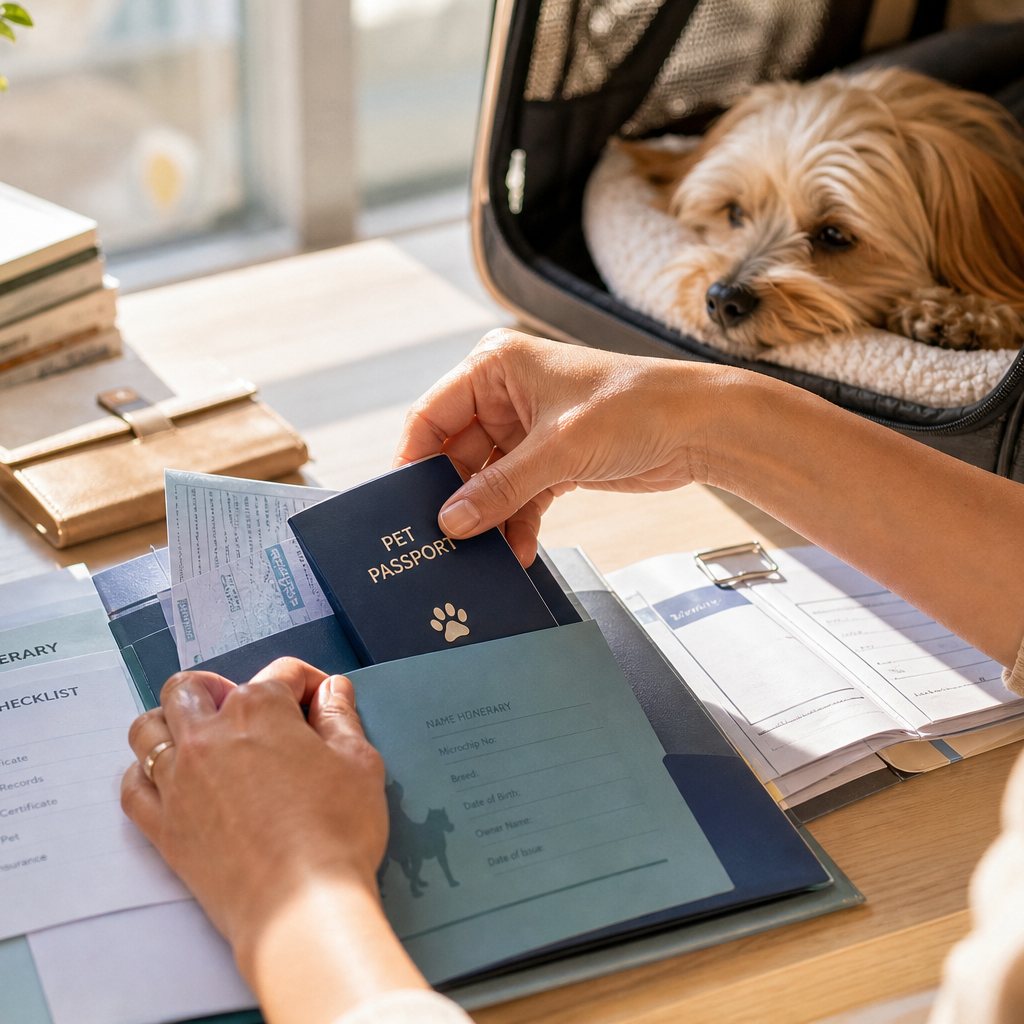
Make sure the crate meets the size and material requirements specified by the airline you plan to fly with, and get your pet used to the crate well in advance. Also check that there is enough space inside for your pet to stand up and turn around, and that the door and latches are securely fastened. It’s a good idea to prepare a checklist of items to bring on the day of travel well in advance.
How to Choose a CrateThe Complete Guide to Choosing a Crate, Safety measures in the cabin and cargo hold, as well as preparations for emergencies, areA Guide to Safety Precautions for Traveling by Air with Your PetThis is explained in detail there.
Checklist of Items to Bring on the Day of Your Flight
If you’re taking your pet on a long-haul flight for the first time, getting them used to their crate a few weeks before departure can help them stay calm on the day of the flight. Even pets that resist at first often gradually get used to it if you slowly associate the crate with positive experiences, such as giving them treats inside it.
Frequently Asked Questions (FAQ)
Summary: Choosing an airline starts with deciding whether to carry your luggage on board or check it
When choosing a pet-friendly airline, the first thing to consider is whether your pet will travel as a “carry-on” or in the “cargo hold.” Once you’ve done that, comparing factors such as the types of animals accepted, accommodations for brachycephalic breeds, and route networks will make it easier to narrow down your options. However, the trends for each airline described in this article are only a general guide. Since pet policies are subject to change at the airline’s discretion, be sure to check the latest acceptance conditions on the official website of the airline you plan to fly with before making a reservation.
Once you’ve confirmed the airline’s requirements, the next step is to check the quarantine requirements for your destination and the departure and entry procedures for Japan. Since both of these require a certain amount of time to prepare, the best way to avoid problems on the day of travel is to start planning by working backward from your confirmed travel date as soon as your trip is finalized. The acceptance requirements for brachycephalic breeds areSummary of Airline Acceptance Policies for Brachycephalic Breeds, Safety Measures in the Cabin and Cargo Hold areA Guide to Safety Precautions for Traveling by Air with Your Pet, Here's an overview of everything from travel preparations to what to do once you're there:A Guide to Preparing for Overseas Travel with Your PetPlease take a look at this as well. If you have any questions or concerns, please feel free to contact PetAirJPN.
🐾 Traveling abroad with your pet, start with a free consultation
Please let us know your destination, desired departure date, and pet situation.
A summary of the required procedures and deadlines will be provided.
Completely free of charge|Online support available|Open on weekends and holidays
Written by: PetAirJPN Editorial Department (International Pet Transportation Operations Team)
*The information in this article is current as of August 2026. Quarantine regulations in various countries and airline policies are subject to change without notice. This article is intended to provide general information only; to determine whether travel is permitted and to confirm specific requirements, please be sure to check the latest official information from the relevant national authorities, animal quarantine offices, and airlines.



 English
  Japanese
  Chinese
  Korean
  German
  Spanish
  Portuguese