

Last Updated: July 29, 2026
What this article will tell you
- Basic Rules for Microchips, Rabies Vaccinations, and Deworming Required for Entry into the United Kingdom
- Schedule for Export Procedures at Japanese Animal Quarantine Stations
- Differences Between Direct Flights (Cargo Transport) and Routes via France (Using the Eurotunnel): Two Options
- Concepts and Precautions Regarding "Dangerous Dog Breeds" (Banned Dogs)
- Key Points for Re-registering Your Pet's Microchip and Finding a Place to Live After Arriving in the UK
- Common Mistakes During Preparation and How to Avoid Them
Why is it said that traveling to the UK with a pet is difficult?
The United Kingdom is considered a country with virtually no cases of rabies, and it has strict rules regarding the importation of dogs and cats from other countries. The order in which microchips must be implanted and rabies vaccinations administered is strictly specified, and for dogs, treatment to eliminate Echinococcus (tapeworms) is also mandatory. In addition, when traveling by air, pets other than service animals are often not permitted in the passenger cabin and must generally be transported in the cargo hold. Since handling procedures vary by airline and route, please refer to each airline’s official information for details, orGOV.UK Official Websiteplease check there.
On the other hand, if you first travel to another EU member state, such as France, and then take the Eurotunnel (Le Shuttle) to reach the British mainland by land, some airlines allow small pets to travel in the cabin, which may help reduce the stress on your pet. In this article, we’ll compare direct cargo transport with the route via France, while explaining the requirements and procedures for entering the UK, as well as key points for your pet’s life there.
What are the basic rules for entering the United Kingdom?
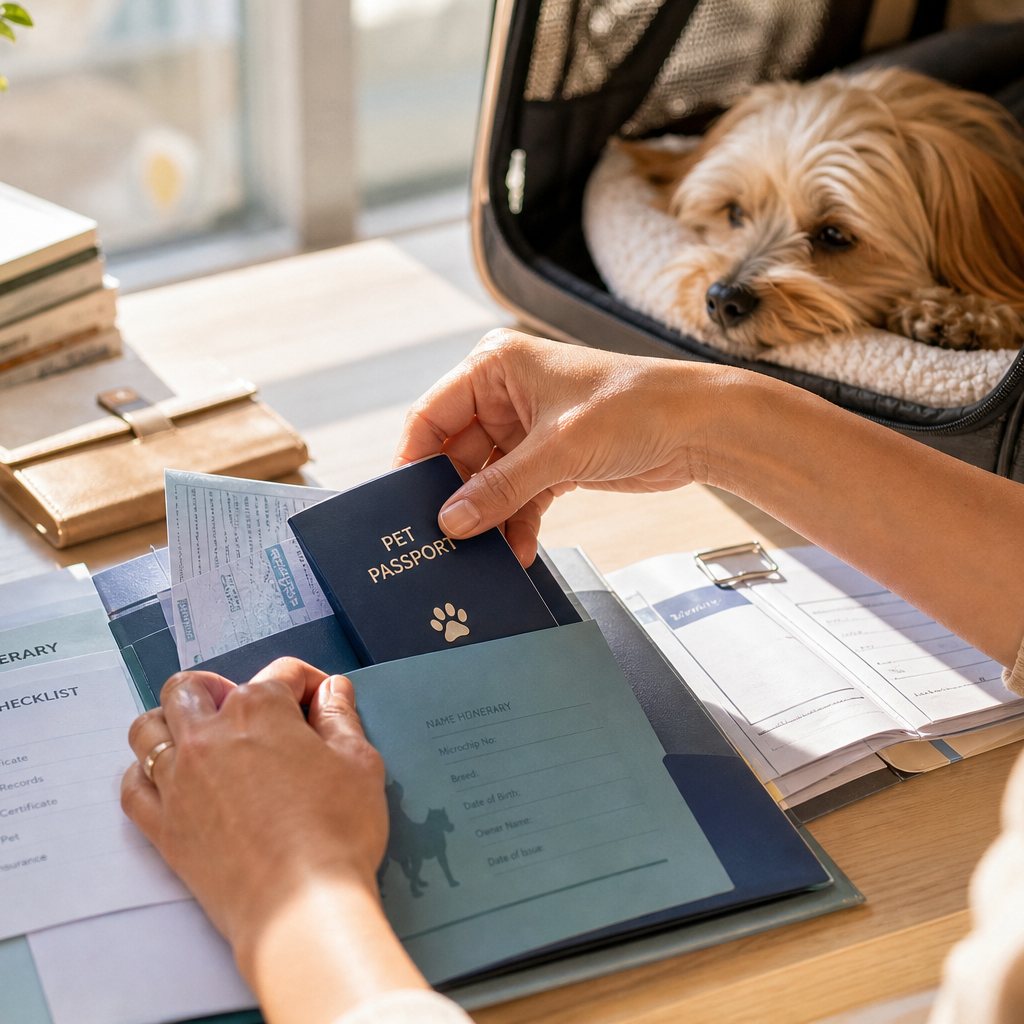
To enter the United Kingdom, you must strictly follow the sequence of microchipping followed by rabies vaccination, ensure your dog has been dewormed, and complete export procedures at the Japanese Animal Quarantine Station. The requirements and deadlines for each step are explained in order below.
Order of Microchip Implantation and Rabies Vaccination
In the United Kingdom, you must follow the procedure of first microchipping your pet and then having it vaccinated against rabies (Source: GOV.UK “Bring Your Pet to Great Britain”(Confirmed in July 2026). Even if both procedures are performed on the same day, the sequence requirement is met as long as the microchip is implanted first. Conversely, please note that if the vaccine is administered first, the requirement will not be met. Since specific conditions—such as microchip specifications and reader compatibility—may vary depending on the individual animal and vaccination status, please check the latest requirements on the official GOV.UK website or with your veterinarian before having the microchip implanted.
If your pet is receiving a rabies vaccine for the first time, a waiting period of at least 21 days must elapse after vaccination. Previously, the standard was uniformly “at least 21 days,” but starting in December 2025, the required waiting period may vary by vaccine depending on the time to onset of efficacy specified in the vaccine’s package insert. Additionally, if your pet has been receiving regular booster shots within the vaccine’s validity period, the waiting period requirements may differ from those for the initial vaccination. Be sure to check with your veterinarian or the official GOV.UK website for the latest guidelines to determine which category applies to your pet.
From the UK’s perspective, Japan is classified as a “listed country,” and a rabies antibody titer test is not required for travel. However, since the classification of countries may be revised, before departure,GOV.UK "Listed and Unlisted Countries"Please check the latest classification here.
Treating Echinococcus (Tapeworm) in Dogs
For dogs, a tapeworm treatment must be administered between 24 hours and 120 hours (5 days) prior to arrival in the UK, and a veterinarian must document this in a certificate (Source: GOV.UK “Bring your pet to Great Britain,” verified in July 2026). This requirement applies only to dogs and does not apply to cats. Since failing to administer the medication at the correct time will result in non-compliance with the requirement, it is advisable to coordinate the administration date with your veterinarian as soon as your flight schedule is confirmed.
Export Procedures at Japanese Animal Quarantine Stations
Before departure, you must have your pet inspected for export at a Japanese animal quarantine station. The desired inspection date isAt least 14 days beforeApply for an export inspection using NACCS (Animal Quarantine-Related Operations), andWithin 10 days of departureI will undergo an examination (Source: Animal quarantine office "to export dogs and cats."(Confirmed in July 2026). After the inspection, the GB Pet Health Certificate (an animal health certificate in the format required by the UK government) will be issued (Source: GOV.UK “Great Britain Pet Health Certificate”(Confirmed in July 2026). It’s easy to confuse this with the rule that “applications must be submitted at least 10 days in advance,” but it’s best to remember that the deadlines for submitting an application and conducting the inspection are separate.
This GB Pet Health Certificate will become invalid if the pet does not enter the United Kingdom within 10 days of issuance (Source: GOV.UK “Great Britain Pet Health Certificate”(Confirmed in July 2026). Be sure to plan your flight and ground transportation schedules in advance, taking into account the validity period of your certificate.
Notice Regarding Dangerous Dog Breeds (Banned Dogs)
The United Kingdom has regulations on dangerous dog breeds under the “Dangerous Dogs Act,” and, as a general rule, dogs falling under these regulations are not permitted to be brought into the country. According to the official GOV.UK website, whether a dog is subject to these regulations is determined not by its breed name, but byPhysical Characteristics (Types)It explicitly states that dogs will be judged based on this criterion, so even mixed-breed dogs may be eligible if their appearance meets the criteria (Source: GOV.UK "Banned Dogs"(Confirmed in July 2026). The rules may vary depending on individual circumstances, such as if you hold a valid Certificate of Exemption. If you believe your dog may fall under one of the eligible categories, do not make assumptions about the breed or number of dogs on your own; be sure to check the official GOV.UK website before traveling to confirm the latest information applicable to your specific situation.
In addition, if the requirements are not met, a quarantine period of up to four months may be imposed (Source: GOV.UK, “Bring your pet to Great Britain,” verified in July 2026). Be sure to check that you have met all requirements—including microchipping, rabies vaccination, deworming, and the validity period of certificates—without exception before departure.
Summary of Basic Entry Requirements for the United Kingdom
- Have the microchip implanted first (it’s okay if it’s done earlier in the day, even on the same day)
- After that, receive the rabies vaccine (the first dose must be administered at least 21 days after the previous dose; requirements may vary depending on whether it is a booster shot or the specific vaccine used).
- Dogs must be administered an echinococcosis treatment (within 24 to 120 hours prior to arrival) and have this documented by a veterinarian.
- Apply for an export inspection at a Japanese animal quarantine station (no later than 14 days before the desired inspection date) and undergo the inspection (within 10 days of departure).
- Enter the United Kingdom within 10 days of the certificate's issuance
- Check for any physical characteristics that indicate the dog belongs to a dangerous breed (determined by appearance, not breed name; treatment may differ if a certificate of exemption is provided).
For those who are worried they might be following the wrong procedure
Please let us know your planned travel dates and your pet's current situation.
Here is a step-by-step guide to the microchip, vaccination, and quarantine certificate process.
What is the process for shipping cargo on a direct flight?
For direct flights, the process involves making a reservation with the airline (cargo division), completing check-in procedures at the departure airport with a certificate issued by the animal quarantine office, and verifying documents and microchips at the animal quarantine facility at the destination. Most airlines transport general pets in the cargo hold as a standard practice.
Why Can't I Bring a Guest to My Room?
On direct flights to the UK, many airlines do not allow pets other than service dogs to travel in the cabin, so regular pets are generally transported in the cargo hold. Assistance dogs—such as guide dogs, hearing dogs, and service dogs—are dogs that support people with disabilities and are distinguished from general pets. This difference in handling is the main factor that increases the burden on both pet owners and their pets when choosing a direct flight. For details on handling procedures, please check the official website of the airline you are using orGOV.UK Official Websiteplease check there.
General Flow of Freight Transportation
Reservations with Airlines (Cargo Division)
Please provide the pet's species, size, and the weight of its carrier, and we will confirm coordination with your scheduled flight.
Check-in Procedures at the Airport on the Day of Departure
Bring the export certificate issued by the Animal Quarantine Service and check your pet in at the cargo area. An Air Waybill will be issued.
To the animal quarantine facility at the destination
After completing the immigration procedures for humans, the pet owner must have their documents and microchip verified at the animal quarantine facility and pay the required fee. If there are no issues, the owner can pick up their pet; however, the document verification and cross-checking process takes some time.
Advantages and Disadvantages of Direct Cargo Shipping
Benefits
- Since it's a direct flight, the flight time is short and there's less hassle with connecting flights at layover points.
- The required documents are based solely on UK requirements, so the process is relatively simple.
demerit
- The cargo fees tend to be higher for large dogs and long-haired breeds (please contact the airline for specific rates).
- Spending long periods of time in the cargo hold causes significant stress for pets.
- It takes a certain amount of time to check and verify documents upon arrival.
Features of Direct Freight Forwarding
- Short flight time
- The paperwork is relatively simple, as it follows only U.K. requirements
- Spending a long time in the cargo hold can be very stressful for pets.
- Fares tend to be higher for large dogs and long-haired breeds.
- It takes some time to pick up the item after it arrives.
How is traveling via France using the Eurotunnel different?
When traveling via France, some airlines allow small pets to travel in the cabin, and if you use the Eurotunnel (Le Shuttle), you can drive your car to the UK, which may allow you to avoid checking your pet as cargo. However, this involves additional effort to comply with the entry requirements of both the EU and the UK.
In some cases, you may be allowed to bring your pet with you on the flight when entering France
On flights to other EU member states, such as France, some airlines allow small dogs and cats to be brought into the cabin. Since requirements (such as weight and carrier size) vary by airline, be sure to check the official website of the airline you plan to use for the latest information.
Large pets may be transported in the cargo hold as checked baggage; however, while some countries and airlines—such as those in the UK—have a blanket policy of “cargo only,” there are also cases where they can be checked as baggage. Since policies vary by country and airline, while this approach tends to be less stressful for pets compared to direct flights to the UK, be sure to check the official website of the airline you plan to use.
To the UK via the Eurotunnel (LeShuttle)
When traveling from France to the UK, you can choose between a ferry or the Eurotunnel (LeShuttle; formerly known as Eurotunnel). The Eurotunnel is a system where vehicles are loaded onto an undersea train, which crosses the English Channel in about 35 minutes (Source: LeShuttle Official Website(Verified in July 2026).
A major advantage of using a rental car or other pet-friendly transportation options is that your pet can stay with you in the car, eliminating the need to check it into the cargo hold a second time.
Please be aware that this can easily lead to duplicate procedures
The route via France must comply with both the EU (France) entry requirements and the UK entry requirements (Pet Travel Scheme). While the basic requirements for rabies vaccinations and microchips are largely the same, you may need an EU health certificate upon arrival in France, and the timing requirements for your dog’s echinococcosis treatment may be re-verified upon entry into the UK. To ensure a smooth process, it is best to have the Animal Quarantine Service prepare the forms for both the UK and the EU before departing Japan.
Key Points of the Route Through France
- Some airlines allow small pets to be carried on board (check with each airline for specific conditions).
- We need to comply with the entry requirements of both France and the United Kingdom.
- On the Eurotunnel, you can travel in the same car as your pet
- Paperwork can be complicated, but it may help reduce the burden on your pet.
Should I choose a direct flight or one via France?
Both options have their pros and cons. The best option for you will depend on your pet’s size and health, your budget, and how much flexibility you have in your schedule, so please use the table below as a guide for comparison.
| Items | Direct UK (freight forwarding) | Via France (Carry-on/Checked Baggage + Eurotunnel) |
|---|---|---|
| Mode of Transport | As a general rule, this item must be transported in the cargo hold. It may not be carried in the passenger cabin. | Small dogs and cats may be allowed to travel in the cabin. Large dogs and cats are more likely to be checked as baggage. |
| Cost Trends | The larger the dog, the higher the cargo fees tend to be (please check with the airline for specific amounts). | While you'll have to pay for airfare, the Eurotunnel, and local transportation, this may still be more cost-effective than shipping a large dog as cargo. |
| Strain on Your Pet | Since they spend long periods of time in the cargo hold, the physical strain tends to be significant | Since they can travel using the same mode of transportation as their owners, it’s easier to reduce their stress. |
| Procedural hassles | Covers only the entry requirements for the United Kingdom | Dual document management is required for the EU (France) and the UK |
| Flow after arrival | It takes a certain amount of time to verify and cross-check documents at animal quarantine facilities. | After clearing customs on the French side, you can continue your journey by car through the Eurotunnel. |
Source: GOV.UK “Bring Your Pet to Great Britain”/LeShuttle Official Website(Verified in July 2026)
Pet Ownership in the UK: What About Licenses, Housing, and Insurance?
After arriving in the UK, you’ll need to establish a foundation for your life there, including re-registering your pet’s microchip in the local database, finding a pet-friendly place to live, and enrolling in pet insurance to cover veterinary expenses. We’ll go through these steps one by one below.
Microchip Registration and Collar Tags
In the United Kingdom (England, Wales, and Scotland), microchipping dogs is required by law. As for cats, microchipping became mandatory in England starting in June 2024. As far as we could confirm in this article, there is no mandatory microchipping requirement for cats in Wales or Scotland (the regulations differ from those for dogs). Even if your pet is microchipped in Japan, you may not meet the requirements unless you re-register your owner information in a UK-approved database, so please complete this procedure as soon as possible after arrival.
In addition, when walking your dog in public places, you are required to attach an ID tag with your contact information to the dog’s collar. For details on local rules—such as microchip re-registration and collar requirements—please seeGOV.UK Official WebsiteIt’s a good idea to check with local government sources for more information.
Fewer pet-friendly properties, but improving
Many landlords of rental properties still enforce a “No Pets” policy, so it seems that pet-friendly listings are limited. That said, recent revisions to model lease agreements have shifted toward the principle that “pets must not be refused unconditionally,” making it easier to find such properties than it used to be. Using the “Pets Allowed” filter on major real estate portals is the standard approach, but it’s not uncommon for the search to take some time. For long-haired or large dogs, landlords may require an additional security deposit or proof of pet insurance, so it’s important to negotiate these details in advance.
Veterinary Medical Costs and Pet Insurance
In the UK, private veterinary care is the norm, and there is no public health insurance system for pets (this is also the case in Japan). As a result, surgeries and long-term treatments can incur significant costs, so many pet owners choose to purchase pet insurance. Since premiums and coverage vary significantly depending on the insurance company, plan, and your pet’s age and pre-existing conditions, we recommend comparing multiple providers before signing up. Once you arrive, it’s a good idea to find a local veterinary clinic as soon as possible and make a plan for health checkups and vaccine updates for peace of mind.
Public Transportation and Pets
On some British rail and bus routes, pets are allowed as long as they are kept in a carrier. However, in public places, it is generally recommended that pets be kept on a leash, and cleaning up after your pet is, of course, a mandatory responsibility. An increasing number of cafes and pubs now allow dogs, and it’s becoming easier to take pets out in town; however, for large dogs or pets that tend to bark, it’s essential to be considerate of others and ensure your pet is well-trained.
Tips for Living with Pets in the UK
- Microchips must be re-registered in the local database
- Dog collars must be fitted with an ID tag containing the owner's information.
- When looking for a place to live, use the "Pets allowed" filter
- Consider getting pet insurance and compare the coverage offered by several companies.
- Wear a leash and follow proper etiquette in public places
What are some common mistakes and things to watch out for during preparation?
During the preparation phase, typical mistakes include mixing up the order of microchipping and vaccinations, confusing Japanese application and inspection deadlines, and overlooking the validity period of certificates. We have summarized some common patterns below.
The requirements listed here are subject to change. Before you begin preparing,GOV.UK Official WebsiteandOfficial Website of the Animal Quarantine ServicePlease check there for the latest information.
What can PetAir do?
PetAir provides guidance on how to prepare the necessary documents for travel to the United Kingdom and compiles information regarding animal quarantine procedures. We also provide comprehensive support for your pet’s travel, including coordinating with airlines and freight forwarders based on your specific situation—such as direct cargo transport or traveling via France with your pet as a cabin companion or checked baggage—as well as guidance on customs clearance and handling the handover at the airport. Please let us know your destination, scheduled departure date, and your pet’s condition, and we will advise you on the necessary preparation time and next steps.
We do not prepare documents or submit applications on your behalf; our services primarily focus on organizing the necessary information and guiding you through the process. We do not guarantee entry into the destination country, confirm flight reservations, or guarantee your pet’s health. Please consult with your pet’s owner and your regular veterinarian regarding medical treatment, vaccinations, and health management at a veterinary clinic. Fees vary depending on the destination, travel dates, and your pet’s condition, so we will provide an estimate when you contact us.
Frequently Asked Questions (FAQ)
Summary: The Best Route and Proper Procedures Ensure Peace of Mind for Both Pets and Their Owners
There are two main routes for traveling with pets from Japan to the UK: a direct flight (as cargo) or a route via France (traveling in the cabin or as checked baggage plus the Eurotunnel). Both routes require compliance with UK entry requirements (such as the order of microchipping and rabies vaccination, and deworming for dogs); when traveling via France, EU requirements are also added, resulting in double the paperwork.
From the perspective of minimizing stress on your pet, the route via France—which avoids long-haul transport in the cargo hold—may be a strong option, though it involves more paperwork. Upon arrival in the UK, you’ll also need to re-register your pet’s microchip with the UK database, find a pet-friendly residence, and set up your new life, including finding a veterinary clinic and arranging pet insurance. If you provide us with your destination, planned departure date, and your pet’s condition, PetAir will advise you on the necessary preparation time and the steps to take.
🐾 Traveling to the UK with Your Pet: Start with a Free Consultation
Please let us know your destination, desired departure date, and pet situation.
A summary of the required procedures and deadlines will be provided.
Completely free of charge|Online support available|Open on weekends and holidays
Written by: PetAirJPN Editorial Department (International Pet Transportation Operations Team)
*The information in this article is current as of July 2026. Quarantine regulations in various countries and airline policies are subject to change without notice. This article is intended to provide general information only; to determine whether travel is permitted and to confirm specific requirements, please be sure to check the latest official information from the relevant national authorities, animal quarantine offices, and airlines.
References:GOV.UK “Bring Your Pet to Great Britain”/GOV.UK “Great Britain Pet Health Certificate”/GOV.UK "Banned Dogs"/LeShuttle Official Website/Animal Quarantine Service, MAFF

 English
  Japanese
  Chinese
  Korean
  German
  Spanish
  Portuguese