
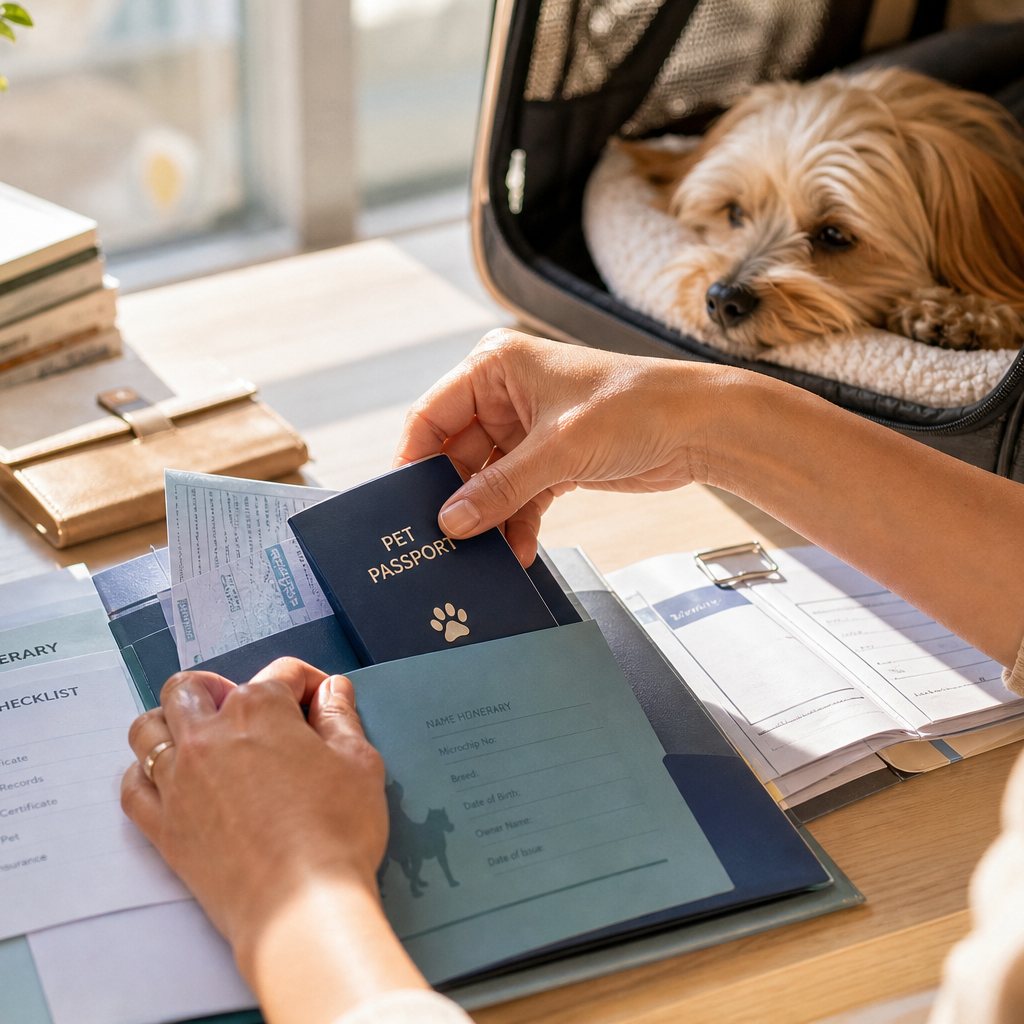
![A Guide to Preventing Your Pet from Being Denied Entry or Sent Back When Traveling Abroad [Updated for 2026]](https://petair.jp/wp-content/uploads/2025/02/The-risk-of-deportation-when-traveling-abroad-with-pets.jpg)
Last Updated: August 1, 2026
Is it "deportation" when a pet is not allowed to enter the country? The correct terms are "denial of entry" and "return."
No, strictly speaking, it is not “forced repatriation.” When a pet is not permitted to enter the country at the airport, it is more accurate to refer to this as “denial of entry” or “return.” “Forced repatriation” is a common expression used in media reports and news stories, but Japan’s Animal Quarantine Service uses the terms “detention for inspection” and “return” to describe its handling of pets that do not meet import requirements and does not use the term “forced repatriation.” In this article as well, we will use the terms “denial of entry” and “return” for the remainder of the explanation.
Two Procedures Outlined by the Animal Quarantine Service (When Importing Dogs and Cats from Areas Other Than Designated Regions)
- Dock Inspection:A measure to board dogs and cats at designated facilities for up to 180 days and keep them there until they meet import requirements
- Return:Arrangements for Returning Pets to Their Country or Region of Origin
Source: Animal Quarantine Service: “Importing Dogs and Cats into Japan (From Areas Other Than Designated Regions)”(Date of confirmation: August 1, 2026)
This is one example of the procedures Japan outlines for travelers as an importing country. While the names of the systems and specific procedures vary by destination, the basic framework—where entry is denied due to incomplete documents or failure to meet requirements, necessitating further action—remains the same. Be sure to verify the official regulations of your destination by consulting information from local authorities or your country’s embassy or consulate.
In what situations might a pet be denied entry or sent back?
Under what circumstances might a pet be denied entry or sent back? Here, we outline three typical scenarios that can arise due to insufficient preparation of documents or failure to meet quarantine requirements. Please note that these are general examples of situations that can occur due to inadequate preparation, rather than specific cases. The Ministry of Foreign Affairs also emphasizes the importance of checking the destination country’s regulations in advance when importing or exporting pets (Ministry of Foreign Affairs: “Import and Export of Pets and Other Animals”(Date of confirmation: August 1, 2026).
Case 1: Incomplete Information on a Health Certificate
If a health certificate issued by a veterinarian does not accurately list your pet’s identification information or records of required vaccinations, local quarantine officials may point out that the documents are incomplete. The same applies if the format or language of the certificate differs from the requirements of your destination.
Possible impacts:This could result in the pet being denied entry and sent back to the country of origin, or the owner being required to cover transportation and boarding costs.
Case 2. Microchip Reading Error
Even if your pet has a microchip, problems may arise during immigration inspection if the reader used at your destination cannot read it correctly.
Possible impacts:They will be held at a local quarantine facility for an extended period, placing a significant emotional and financial burden on their owners.
Case 3. Failure to Meet the Standards for Rabies Antibody Titer Testing
Even if you have received the required vaccinations, you may be denied entry if the results of your rabies antibody test do not meet the standards of your destination country.
Possible impacts:This will cause significant delays in your travel or relocation plans, resulting in you missing the opportunity to start your new life with your pet.
What Are the Main Reasons for Entry Denial or Deportation? An Explanation Along with 6 Countermeasures
We’ve compiled a list of six common reasons that can lead to entry denial or deportation. Please review this list along with the corresponding countermeasures.
Incomplete documentation
If there are errors in the information listed on documents such as health certificates, vaccination certificates, or import permits (e.g., name, identification number, date of vaccination), or if the required documents are incomplete, you will be flagged during immigration inspection. The required document formats and languages also vary depending on your destination.
When taking dogs or cats out of Japan, you must apply for an export inspection through NACCS (Animal Quarantine Services) at least 14 days before your desired inspection date, and have the animal undergo an export inspection at an animal quarantine station within 10 days of departure.Export Quarantine CertificateYou must receive a copy of (Animal Quarantine Station “Export Inspection”(Date of confirmation: August 1, 2026). The estimated time required for procedures on the Japanese side isTime Required for Pet Transportation ProceduresIt also explains that.
Measures:Be sure to double-check the expiration dates and details on each document before departure, and contact the embassy, consulate, or animal quarantine office of your destination country to confirm the latest information.
The Microchip Issue
Many countries require pets to be microchipped. Even if a pet is microchipped, there may be issues with reading the chip locally if the microchip does not meet the destination country’s requirements or if the registration information is not up to date.
For example, the EU (European Union) requires microchips that comply with international standards. The specific technical requirements are:European Commission Official WebsitePlease check here (as of August 1, 2026). Since the required standards vary depending on your destination, it is essential to check in advance.
Measures:Before departure, check that the microchip is properly installed and registered at a veterinary clinic, and, if possible, consider testing whether it can be read by the readers used in the destination country.
Non-compliance with import regulations in the destination country
Depending on the country or region, there may be restrictions or bans on importing pets of certain breeds, ages, or health conditions. The specifics of these restrictions vary widely by country and are subject to change.
Measures:Be sure to check the official information from the embassy, consulate, or quarantine authorities of your destination country regarding the latest import restrictions and required procedures. It is important not to make decisions based solely on information from third-party websites.
Shortcomings in Rabies Prevention Measures
After receiving a rabies vaccination, it takes a certain amount of time for antibody levels to reach the required threshold. It also takes time to receive the results of the antibody titer test.
For your reference, when importing dogs or cats into Japan from outside designated areas (including when returning to Japan), the animal must be microchipped, receive at least two rabies vaccinations, and have an antibody titer of 0.5 IU/mL or higher confirmed; after that, a waiting period of at least 180 days following the blood draw is required (Official Animal Quarantine Office(Last checked: August 1, 2026). Since the requirements vary by destination, be sure to check the official information provided by local authorities.
Measures:Once you’ve finalized your travel or relocation plans, be sure to schedule your vaccinations and antibody tests as early as possible.
Lack of waiting period
In some countries and regions, you are required to wait for a certain period of time after receiving a vaccination. Whether a waiting period is required and how long it is varies depending on your destination.
Measures:Check early on whether there is a waiting period and how long it is, and plan your preparations with plenty of time to spare.
Final decision by local authorities
Even if all the necessary documents and test results are in order, if local quarantine officials have concerns about your pet’s health, this may lead to additional checks or denial of entry.
Measures:Before traveling, have your pet undergo a health checkup by a veterinarian to confirm that your pet is in good health.
| Main Causes | Key Points of the Measures |
|---|---|
| Incomplete documentation | Double-check the details and expiration date before departure. |
| Microchip Non-Compliance with Standards | Check the installation and registration status and specifications in advance |
| Non-compliance with Import Regulations | Check the latest official information for your destination |
| Shortcomings in Rabies Prevention Measures | Plan your vaccination and antibody titer test schedule well in advance |
| Lack of waiting period | Check in advance whether there is a waiting period and how long it is |
| Final decision by local authorities | Get your pet in good health with a pre-trip checkup |
What happens if you're denied entry or sent back?
If a pet is denied entry or sent back, how will this affect the owner and the pet? We have summarized the main potential impacts.
Possible Consequences of Denial of Entry or Deportation
- Return to the Country of Origin:Pets may be returned to the country or region from which they originated.
- Cost Responsibility:The costs associated with returning or boarding a pet are generally the responsibility of the pet owner. Since the specific amounts can vary significantly depending on the destination, the airline, and the pet’s size, please check with the airline or the authorities at your destination in advance.
- Long-term mooring on site:Depending on your destination, your pet may be held at the airport or a quarantine facility for an extended period of time.
- Impact on Planning:Your travel or relocation plans may be significantly delayed or canceled.
According to the Animal Quarantine Service guidelines, if you import dogs or cats from areas other than designated regions and do not meet the import requirements, the quarantine period may last up to 180 days (Official Animal Quarantine Office(Verified on August 1, 2026). We recommend allowing for a buffer in your schedule and budget in case the process takes longer than expected.
For those who want to know what preparations are needed for each destination
Please let us know your destination and planned departure date. We’ll let you know how much time you’ll need to prepare and what the first steps are.
Checklist for Reducing the Risk of Entry Denial or Repatriation
We've compiled a list of key points to check before departure, organized by category. Go through the list to make sure you haven't missed anything in your preparations.
information gathering
Document Preparation
Microchip
Rabies Prevention Measures
Health checkups
Transport preparation
Insurance and Consulting with Experts
Summary: Accurate information and early preparation reduce the risk of being denied entry or sent back
Moving abroad or traveling overseas with your pet can be done with peace of mind as long as you plan ahead and stay up to date on the latest information. Ensuring your documents are accurate, verifying that your pet’s microchip is compliant, taking precautions against rabies, and confirming the required quarantine period—by carefully following each step, you can significantly reduce the risk of being denied entry or having your pet sent back. The latest regulations are,Animal Quarantine Service: "Import and Export of Animals"Be sure to check regularly using official information from the Ministry of Foreign Affairs (Last checked: August 1, 2026).
Regulations at your destination vary by country and region and are subject to change. If you have any concerns, please feel free to contact PetAirJPN early in your planning process. We will propose a plan tailored to the regulations at your destination and provide support with preparing the necessary documents and navigating the procedures.
Frequently Asked Questions (FAQ)
🐾 Traveling abroad with your pet, start with a free consultation
Please let us know your destination, desired departure date, and pet situation.
A summary of the required procedures and deadlines will be provided.
Completely free of charge|Online support available|Open on weekends and holidays
Written by: PetAirJPN Editorial Department (International Pet Transportation Operations Team)
*The information in this article is current as of August 2026. Quarantine regulations in various countries and airline policies are subject to change without notice. This article is intended to provide general information only; to determine whether travel is permitted and to confirm specific requirements, please be sure to check the latest official information from the relevant national authorities, animal quarantine offices, and airlines.

 English
  Japanese
  Chinese
  Korean
  German
  Spanish
  Portuguese